

Editor’s note: This profile is part of our 11 Women to Watch in Science package.
Every summer on a family farm in Central Turkey, Dr. Yagmur Yegin learned what it meant to lose food. Too much rain, or not enough, and the apples spoiled before they could be used. Years later in a lab at the Massachusetts Institute of Technology, she set out to solve a different — but familiar — problem: How do we keep food fresh, longer?
“Sometimes we had droughts, or too much rain, and lost everything,” she said. “That pain of seeing food go to waste stuck with me.”
Today, Yegin is a food scientist developing edible, silk-based coatings that extend the shelf life of fresh produce without refrigeration. Her research, conducted during her postdoctoral work at MIT, creates a transparent, tasteless coating that significantly slows decay.

In places without cold storage, this technology could cut waste and emissions. Yegin envisions farmers spraying the coating on produce immediately after harvest, buying them crucial days of freshness to cut food waste, generate more income, and reduce methane emissions from rotting food.
She’s now refining the solution into dissolvable paper sheets that can be mixed with water and sprayed in the field. Working with Engineers Without Borders, Yegin has begun a focus on Kenya, helping efforts there to extend the shelf life and safety of produce there.
According to the United Nations, methane emissions from decomposing food make up nearly 10% of global greenhouse gases. Wasted food also drains close to $1 trillion from the global economy annually.
Originally from Turkey, Yegin completed her bachelor’s degree in engineering at Manisa Celal Bayar Üniversitesi and then moved to the U.S. alone to learn English at Indiana University.
“I told myself, ‘If it doesn’t work out, I can go back’ – and kept moving forward,” she said.
She didn’t go back. She earned a competitive scholarship, a master’s degree and a Ph.D. at Texas A&M University, and eventually a postdoctoral fellowship at MIT. Her research now appears in more than 30 peer-reviewed publications, book chapters and patents. Yegin also mentors early-career scientists through the Association for Women in Science, where she first joined as a mentee.

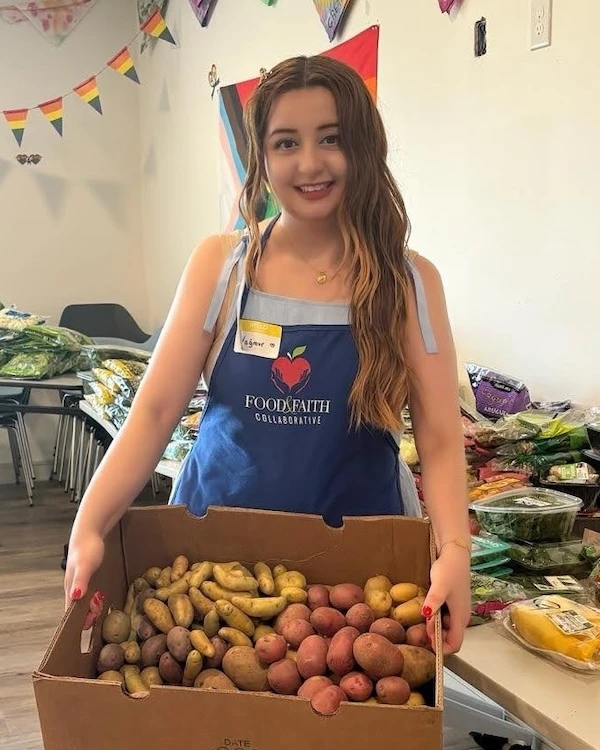
Now based in Houston, Yegin volunteers with Second Servings, a local food rescue organization, to address the downstream impact of food waste firsthand. Even after the collection process and bringing extra food to pop-up markets, there are still leftovers.
Her work ultimately targets this excess. Unlike other shelf-life extenders that require expensive packaging or cold storage, Yegin’s coating can work in resource-limited settings and promises real benefits for growers and retailers alike.
“If my research doesn’t apply to the real world, it loses meaning,” she said.
In many ways, the apple hasn’t fallen far from the tree. Her scientific achievements carry forward the respect for food systems she learned on her grandmother’s farm, now applied to a wasteful world. ◼️
Updated to clarify information about the efforts in Kenya.