

Editor’s note: This profile is part of our 11 Women to Watch in Science package.
Liz Dennett grew up in a small town in Alaska, bordered on every front by vast, rugged wilderness. Surrounded by extreme environments, Dennett was drawn to questions that “lived at the edge of possibility.” Over time, “that led me from astrobiology to geology to subsurface genomics,” she says. “Eventually, I realized the real frontier wasn’t outer space. It was under our feet.”
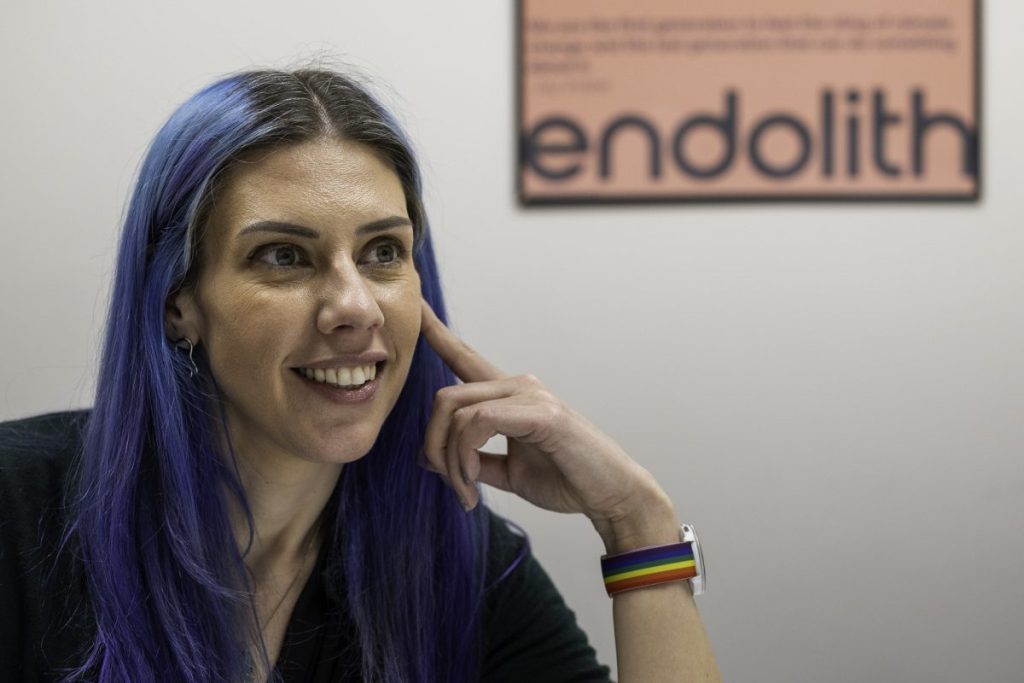
Dennett is the founder and CEO of Endolith, a company that combines biology and machine learning. It uses microbes to extract critical materials – like copper and lithium – from low-grade ore, supplying the minerals needed for electric vehicles, data centers and large-scale battery technologies. (A shortage of copper is one of the biggest threats to the clean energy transition.)
“Basically, we give tiny organisms a really big job,” she laughs.
Now based in Denver, Dennett holds a Ph.D. in geoscience from the University of Wisconsin-Madison, and trained at the NASA Astrobiology Institute. For two decades, she led corporate teams at data giant Wood Mackenzie and cloud provider Amazon Web Services. But she realized she kept seeing the same pattern: “Massive, system-level problems being tackled with outdated tools. Mining was one of them.”

Dennett says the opportunity to apply her biology and data science skills to something as foundational as copper recovery was too good to pass up, and so she decided to launch her startup in 2023.
The company uses microbes, or tiny organisms living in the environment, to unlock low-grade ores – mineral deposits that have just a small amount of the desired material, which would otherwise be wasted. This approach reduces the vast water and energy consumption usually associated with traditional mining methods. Microbes can also help mitigate the environmental impacts of mining through bioremediation, or natural cleaning, of contaminated water and soil.
As much as 70% of copper reserves are in low-grade or hard-to-process ores, while experts predict mineral demand will double by 2040. Dennett’s aim is to offer a cleaner, more scalable path to securing the minerals needed for the transition to clean energy and address the challenge of how to scale clean energy without causing more environmental harm.
Endolith recently closed a round of Series A funding and raised $13.5 million, and announced last year that it had achieved significant breakthroughs in copper extraction. The company pointed to tests that demonstrated its methods were able to access minerals that were either previously inaccessible or economically unviable to process.
To get to where she is today, Dennett has had to ask for help. “A lot,” she adds. “I used to think leadership meant having all the answers. Now I know it’s about asking better questions and building a team that can see things you can’t.”

She continues: “Mining and biotech are both male-dominated fields, as is data science. Working at the intersection of all three means I have had to work harder to be heard or taken seriously.”
When days get hard – and they do, Dennett says – she stays grounded by reminding herself why the work matters. “I remember that the electrons flowing through power lines to power the screen you’re reading this on now, or your phone, and think: ‘This is our shot to help make that possible in a better way.’” ◼️