

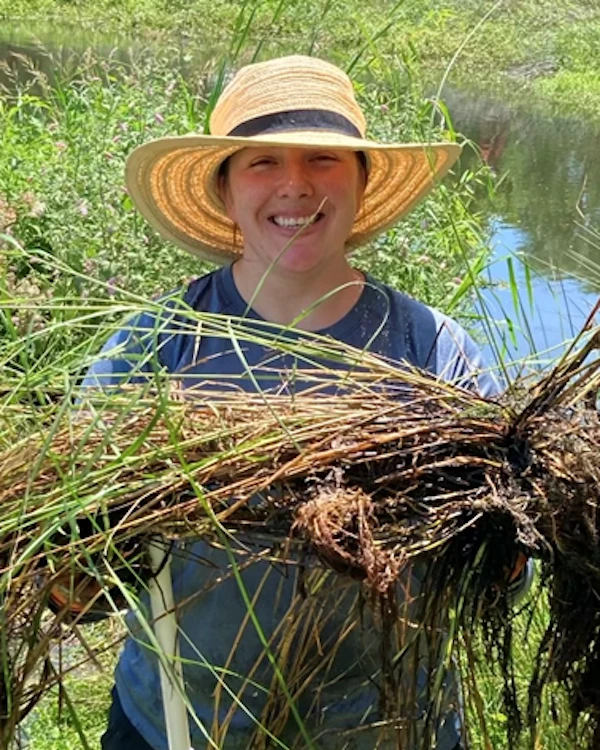
Editor’s note: This profile is part of our 11 Women to Watch in Science package.
Rising global temperatures are expected to bring more frequent and intense rainfall – but many urban areas do not have the adequate infrastructure to cope.
In cities, for example, impervious surfaces like sidewalks and roads prevent water from being absorbed by the soil, which can lead to flooding. Additionally, stormwater can carry pollutants from the urban environment into rivers and oceans, degrading water quality and harming wildlife.
Sarah Waickowski, an assistant professor of agricultural sciences at the Baruch Institute of Coastal Ecology and Forest Science at South Carolina’s Clemson University, has dedicated herself to developing solutions for these water quality issues – and teaching the next generation of engineers how to do the same.

Waickowski’s research evaluates potential solutions to improve water quality and reduce flooding by using stormwater best management practices (BMPs), such as stormwater ponds, bioretention cells (often called rain gardens), green and blue roofs, and permeable pavements.
Waickowski grew up in Fellsmere, Florida. And it was there, at a ninth-grade career fair, that she happened to stumble across civil engineering. “After reading about civil engineers, I decided that’s what I wanted to be,” she remembers. And in 2012, after gaining a bachelor’s degree in civil engineering from the University of Florida, she began working in the field as an extension associate at her recent alma mater, collecting water quality and hydrology data from research projects as well as surveying sites to design stormwater retrofits.
“Initially I wanted to go into consulting, but then I discovered cooperative extension,” she said, referring to community education programs that aim to provide practical knowledge. “Once I realized how much of an impact you can have as a researcher and extension specialist, I decided to earn my Ph.D. and pursue a career in academia at a land grant university.”
Waickowski gained a master’s and a Ph.D. in biological and agricultural engineering from North Carolina State University. She has since moved to Murrells Inlet in South Carolina, where she writes journal articles, teaches cooperative extension programs, supports graduate students and still conducts her own stormwater-management research.
As both an academic and an environmental engineering consultant, Waickowski has worked on numerous stormwater projects to mitigate impacts of climate change and population growth, including North Carolina’s first comprehensive “green street.”
The landmark project in Fayetteville, designed to help manage flooding during storms, was the first of its kind in the state. It’s a single street retrofitted with permeable pavement, bioretention cells – modular units which manage stormwater by filtering pollutants from runoff through vegetation and soil – and suspended pavement systems.

But one of Waickowski’s favorite memories was seeing her first-ever design – a series of bioretention cell planters that retrofitted a small shopping center in Pittsboro, North Carolina – come to life.“It’s just really special to see something go from an idea in your head to an actual thing that you can walk around.”
In spite of her wins, Waickowski isn’t a stranger to challenges, often being the only woman in the room. “I’ve been underestimated a lot,” she says, “which I think everyone experiences at some point in their career. But I decided I was going to prove people wrong by being one of the hardest if not the hardest working person in the room.” She adds with a laugh, “as far as I can tell, it’s worked.”
In addition to her research, Waickowski has taught over 75 cooperative extension workshops, teaching land managers, government officials and the public alike how to manage water.
“Recently, there has been a growing disconnect between scientists and the public,” says Morgan Chaudry, Waickowski’s colleague. “More scientists like Dr. Sarah Waickowski that can bridge the gap between scientific and stakeholder priorities are needed to develop evidence-based solutions to water quality issues that are expected to increase with climate change.”
As for future ambitions, Waickowski simply hopes she can continue the work she’s doing, and make her own mark in the field. “I hope that when people hear my name, they say I’m a gem of a person.” ◼️