

Editor’s note: This profile is part of our 11 Women to Watch in Science package.
When Marianne Cowherd grew up in Ann Arbor, Michigan, she had dozens of snow days, which she often spent sledding and skiing. Snow fell abundantly, and she never heard about droughts or water issues in the local environment. But when she arrived in northern California for college in 2015, she soon found a widespread and urgent conversation happening about water resource problems.
One research project impacted her career trajectory in particular. She was able to work at the University of California, Berkeley’s Central Sierra Snow Lab, an area that measures snow and collaborates with the California Department of Water Resources on water supply issues. “Between spending a lot of time up there, and doing research in water storage and predictability,” Cowherd says, “I got really interested in snow as a water resource – because it has all of these characteristics that rain doesn’t have.”
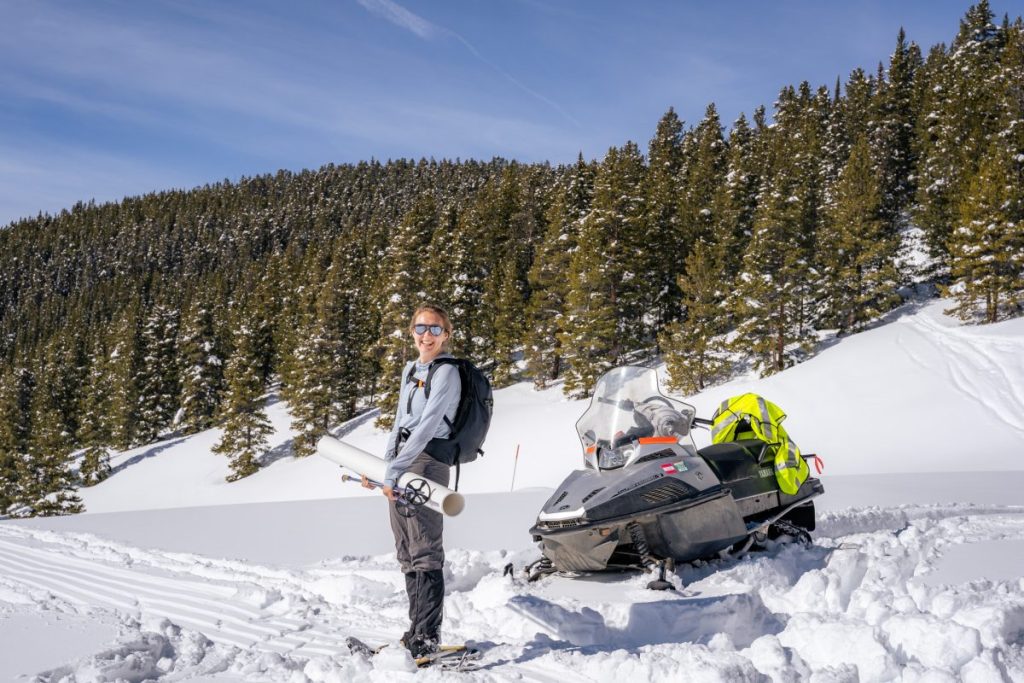
Cowherd is a snow hydrologist, now at Montana State University in Bozeman. She works on questions related to snow’s presence and absence, and how that impacts water supply. Those big questions include exactly how much water will be available from snowfall in any given year – and how that might change in the future, due to climate change.
Studying snow brings with it a whole spectrum of interesting challenges. First, it takes up more volume than rainfall. And second, snowfall can hold varying amounts of water, depending on how fluffy or dense it is. As the climate changes, so do the delicate calculations of where water needs to be, and when it needs to be there, Cowherd says. It’s a challenging dance that changes year to year, and place to place. “One of the downsides is that snow is relatively far away from where most people live and work, and it’s relatively inaccessible,” she adds. “We rely on relatively sparse networks of snow measurements and manual measurements that tell us how much water is going to be available in the spring.”
In Montana – another snowy state, but much drier than where she grew up – Cowherd focuses on predicting snow-related water availability. Measuring snow can be tricky, so she also works on better ways to actually assess the fluffy, frozen water. “Snow is difficult to measure using satellites or airplanes,” she points out. “We don’t really know exactly how good those measurements are going to be in the future, because they are based on past weather – and we expect the future climate to be different.”

The basic message of climate change is readily apparent: A warmer future, with melting glaciers and higher seas. Cowherd wants the public to hear a slightly more nuanced version. “There’s a lot of variability in how snow and ice respond to climate more broadly – it’s not a one-size-fits-all,” she says. “Some places are affected more; some places have increased snow. It’s a problem that is complicated.” ◼️