

Editor’s note: This profile is part of our 11 Women to Watch in Science package.
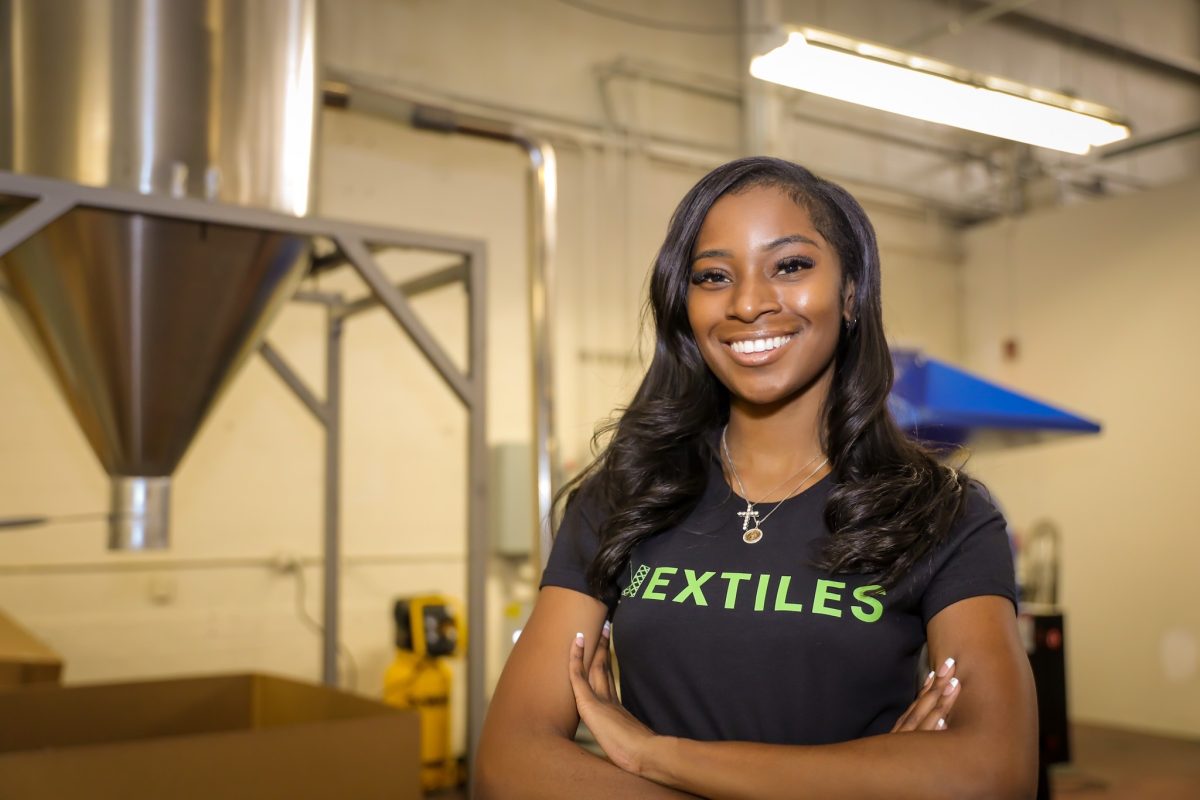
For Madeline Walker Miller, who grew up the daughter of an entrepreneur (her dad) and an energy-efficiency company CEO (her mom), it made sense that she would eventually land in a similar field. The Detroit native is the founder of NexTiles, a company recovering textile waste and giving it a second life – everything from thermal and acoustic building insulation to punching bags and artificial snow for theme parks.
Less than 15% of textiles are recycled, and with approximately 17 million tons being produced every year, that adds up to a lot of waste – 11.3 million tons end up in landfills every year.
Miller turns a growing waste problem into a climate solution, cutting landfill use and associated emissions (landfills are the third largest source of human-related methane waste in the U.S.), as well as lowering utility bills and replacing virgin materials.
NexTiles focuses on pre-consumer waste, or textiles that end up on the cutting room floor during the manufacturing process, working with fashion, automotive and aircraft companies. The materials are shredded, although any large leather hides that are usable are sold and repurposed. The company shreds up to 120,000 pounds a month, and Miller has plans to expand following the purchase of a large warehouse.

“The space is a former film studio, and we found some really cool things when we were cleaning it out, like gator shoes [made from alligator skin], which are kind of like a Detroit staple,” Miller laughs. “And so it just feels right and it feels good to be there.”
Miller started out as a dual-degree engineering major, but took an interest in environmental science toward the end of her undergraduate time at Spelman College in Atlanta. “I didn’t really know what I liked, I just knew I was interested in the impacts of industry and manufacturing on people.”
Eventually she was accepted into University of Miami’s environmental science graduate program, focusing on marine ecosystems. “I wanted to figure out the impacts of microplastics on the ocean, and in my reading and research I landed on fashion as a major contributor to landfill waste, and synthetic fibers that end up in the ocean,” she says. An internship at a New York-based recycler called Fabscrap opened Miller’s eyes to the scale of waste occurring. “I thought it would be really cool to bring something similar to Detroit.”
And being in Detroit, all of Miller’s first clients were automotive. “We just started off doing small local pickups and we’ve grown from there,” she says. “The biggest challenge has been finding the capacity to deal with large amounts of waste.”
Last year, Miller took a risk and bought the warehouse, but she has struggled with the competition against traditional waste disposal methods – like landfills. It’s far cheaper for a company to send their waste to a landfill than to pay NexTiles to dispose of their waste ethically. “Price point, we’re not a landfill competitor – we’re many times the price of what it costs an organization to just landfill their waste,” she says. For that reason, she leans on the corporate responsibility element when she pitches to companies on why they should be upcycling their waste materials, rather than dumping them in landfills.
Related

“It’s still a struggle persuading them,” Miller says. “We’re fortunate to have a pretty steady stream of companies that reach out to us just because there aren’t many people doing what we do. But when we want to go after a client that’s never heard of us, that is not being held accountable for landfilling their waste, then it becomes a bit more difficult.”
Miller and her team are in a “constant cycle of innovation,” needing to figure out how they’re going to upcycle waste materials before they take on new clients.
Miller is now also studying for a Ph.D., with her doctoral research focusing on energy efficiency and affordability in public housing. She hopes eventually to return to her original ambition, which is to upcycle textile waste and make building insulation for social housing which she can sell directly. Currently she sends the raw material to insulation companies who manipulate and treat the product.
“A big ambition of mine,” Miller says, “is to manufacture our own housing insulation products that can be sold in big box hardware stores.” ◼️
This story has been updated to correct Miller’s name and father’s occupation.