

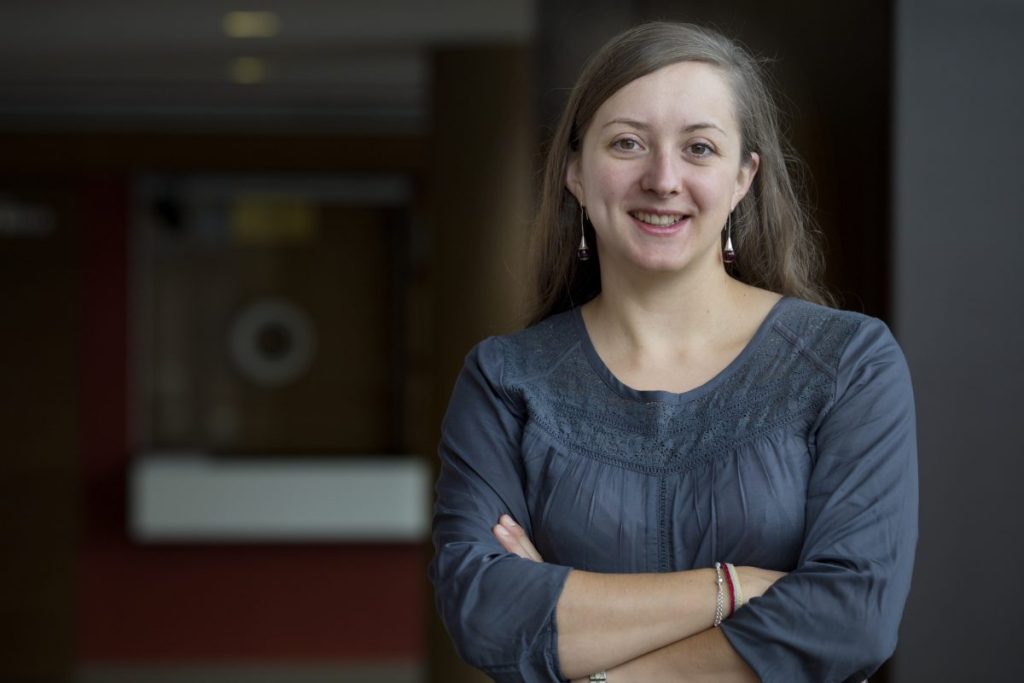
Editor’s note: This profile is part of our 11 Women to Watch in Science package.
Water is all around us: From the respiration in plants to the clouds in the sky to rivers cutting paths through land. When people ask what Cynthia Gerlein-Safdi does, she tells them she works at the intersection of the carbon and water cycles – looking at environmental science on scales both tiny and enormous. “Water is really flowing through our ecosystems,” she says, “and there are so many issues linked to water, both on the science side of things and on the social side.”
At University of California, Berkeley, where she is an assistant professor of civil and environmental engineering, Gerlein-Safdi’s research covers an incredibly broad range – from examining the impact of dew and fog on plants in the Bay Area to monitoring waterways in the tropics via cutting-edge satellite technology. She is particularly interested in how climate change disrupts water cycles and affects disaster management.

At the largest scale, satellites help build an understanding of water moving around the world. Last year, Gerlein-Safdi led research to develop a new way to map water on land in the tropics – technology that can see below clouds and tree canopies to understand how lakes, rivers and wetlands change over the seasons. It’s critical work to predict future flooding, she says, and also to help quantify how much methane is being produced by wetlands.
She also works with the Lawrence Berkeley National Lab in Alameda County, California, on projects to take field samples that link carbon and water in vegetation. She is looking at dew and fog, and trying to build better models of photosynthesis across different sites in the U.S. That information could provide vital background to understanding climate change’s impacts on plants in different areas.
Gerlein-Safdi’s background also straddles borders and ideas. She grew up in Alsace, France – a town that sits between France, Germany and Switzerland. In high school, she remembers learning about plate tectonics in relation to Hawaii: she thought it was “just so cool” that there was one little spot of magma coming from deep inside, creating individual islands as the plates slid over it.
That sparked an interest in the deep interior of Earth, she says. During a research project in her geophysics degree, she started applying geophysical tools to look at plants – by looking at soils and roots. “I went from geology to soils and roots, and then from roots to whole plants,” she says, “and water was always running through.”
She says that as long as she is contributing to human understanding of our kind of natural world – and potentially offering the tools to face hazards like flood – that’s success.
The future questions she hopes to address still contain water. One of the big ones involves searching for water’s pathways though different ecosystems, she says. “Are we seeing kind of large shifts in where water is due to climate change? If the water is no longer at the surface, where is it going?”