

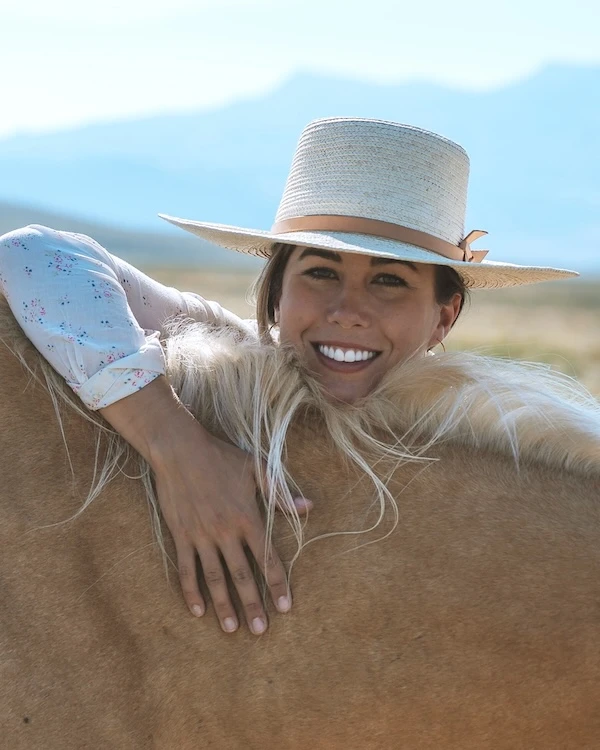
Editor’s note: This profile is part of our 11 Women to Watch in Science package.
In rural areas of the United States, the effects of climate change are here.
For ranchers in the West, drought is an especially large problem – one that is likely to reach unprecedented levels, researchers warn. Ada Smith, a rural sociologist who works with ranching communities throughout the region, has seen the problems this is already causing firsthand. So have the landowners she interacts with.
But implementing new practices to get ahead of the situation is still far easier said than done, she says. Which is why she has made it her mission to better understand the ranchers themselves, including the under-served women in agricultural communities.
Her social-science work examines the human part of conservation and resource management efforts, primarily in Montana – where she lives – as well as Idaho and Wyoming. “My work centers on the social, knowledge and coordination barriers that shape decision-making,” she explains, with the aim being to “connect it all to real-world solutions that support people and the landscapes they depend on.”
There is a significant mental component to the work, Smith says, in addition to the practical and financial realities of implementing these Earth-saving practices.
For starters, ranching – and the science around it – is often generational work, with lands and stewardship practices alike being handed down among families. So “when you think about farmers and ranchers trying to adapt to changing their water development strategies, or planting different crops that are more drought-tolerant,” it can be tough to adjust, she says.
And yes, “there are government programs out there funding some of these things, but the relationship between agency personnel and those on the ground really determines whether a rancher participates.” It’s an aspect not often considered, she adds – the trust and relationship-building necessary to see such efforts put into action. “It’s not as easy as just adopting a practice – they need support.”
Hers is also a field that remains male-dominated, both in terms of who she is working alongside, and who she’s speaking with on the farmland. “Being a female scientist, trying to understand some of these social dynamics” can be challenging. But Smith views it as an opportunity to better understand perspectives that aren’t her own – which then helps her guide officials to do the same.
Her experiences growing up on a farm in a remote portion of Wisconsin, combined with summers at her grandparents’ land in Montana, instilled in her a lifelong love of the “large, open landscapes” she now works to protect. She earned degrees in environmental studies from Wellesley College and the University of British Columbia before receiving a doctorate in society and conservation from the University of Montana.
Now, Smith is a remote-study postdoctoral scholar at Oregon State University. And, as part of her current work, Smith monitors ranchers’ grazing management systems, researches expanding grizzly bear populations, and works with the Montana Drought & Climate Project and state climate officials to better prepare ranchers for what’s coming.
Her experiences, all combined, have shown her that the key to understanding the ranchers and landowners themselves – and helping them combat climate change – is “to understand how they are stewarding those places, what the social drivers are for taking care of these lands, and what kinds of incentives and policies need to be in place to keep them maintained.”
Over the years, she says she has often asked herself: “Why don’t humans do what’s best for the environment?” She says the answers to that question are largely social and cultural, rather than agricultural, in nature. At the end of the day, “effective conservation must be grounded in the lived experiences of the people it is meant to serve.” ◼️