

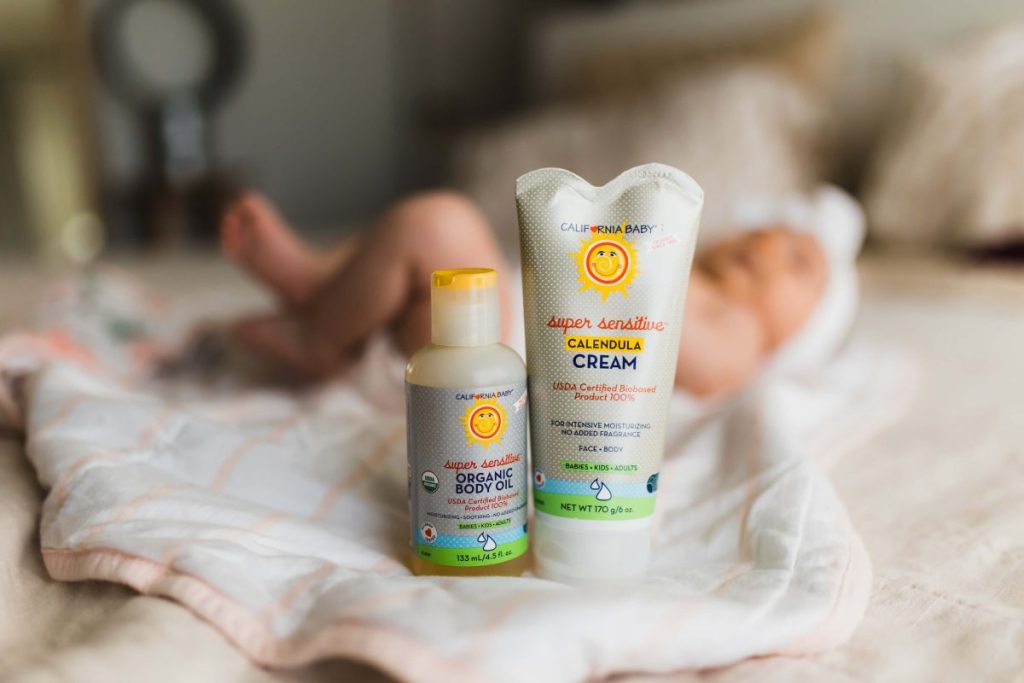
We bring you our fascinating conversation with Jessica Iclisoy, who founded California Baby some 30 years ago.
As a new mom, she randomly spotted a chemical dictionary at her local library — and discovered her son’s baby shampoo was loaded with toxic chemicals. “It’s one of those things where fate puts things in front of you,” she says. Appalled, Iclisoy began an investigation into safer ingredients and ultimately developed her own baby shampoo.
Today, California Baby makes over 200 baby products from ingredients that are grown on its farm in Central California and bottled at its FDA-registered, organic-certified facility in Los Angeles.

COLLEEN: If you've spent some time perusing all the lotions and sunscreens and bubble bath options for your kiddos, you may have seen the brand California Baby.
SUE: Founder Jessica Iclisoy started the company 30 years ago – here she is, talking about that on the Today Show.
JESSICA: Some people start their companies with inspiration. I started mine with outrage.
COLLEEN: We like a good outrage story.
SUE: Yes, we do.
COLLEEN: I'm Colleen DeBaise.
SUE: I'm Sue Williams.
COLLEEN: So today on The Story Exchange –
SUE: Today –
COLLEEN: We bring you our fascinating conversation with Jessica, who now makes over 200 baby products…
SUE: …which are all-natural, plant-based, certified organic.
JESSICA: We're testing all our ingredients because there's tons of greenwashing out there.
COLLEEN: And we'll share how Jessica turned a dogged pursuit for safer baby products into a thriving business empire.
JESSICA: The thing that really drove me to develop California Baby -- I was not starting a business. This was just investigation.
SUE: And you'll learn a bit about things you should and shouldn't be putting on your baby's skin… or anyone's skin, for that matter.
COLLEEN: Stick around.
*Musical Interlude*
COLLEEN: So, let's go back 30 … well, actually, more than 30 years ago.
COLLEEN (from interview): When was your son born? The one who inspired all this.
Jessica (from interview): That was 1990.
COLLEEN (from interview): 1990. Okay.
COLLEEN: Jessica, then just 22, had become a new mom –
JESSICA: In preparation for pregnancy, as a lot of women do, we clean up our lifestyles. We stopped drinking wine, we stopped drinking coffee.
COLLEEN: She takes being from the West Coast very seriously.
JESSICA: I'm in Southern California. We're very crunchy, we can be very organic and crunchy.
COLLEEN: As a gift for her nursery …
JESSICA: I received some conventional shampoo for my baby shower.
COLLEEN: She didn't say the brand, but I'm guessing it was probably something like Johnson and Johnson's baby shampoo. Anyhow -- one day, she's out shopping…
JESSICA: I picked up a shampoo from my local health food store and it said it was all-natural, and of course, it costs more and all of that, but I was happy to pay that extra cost for my health and the health of my newborn.
SUE: So Jessica now has at home, a bottle of Big-Corporate-Made Baby Shampoo and a bottle of the expensive quote-unquote All-Natural Baby Shampoo.
COLLEEN: That's right – so, Jessica – who had worked briefly in fashion, but is now a stay-at-home mom – she's spending a lot of time at her local library, with her little boy, and one day…
JESSICA: I happened to pick up a chemical dictionary.
COLLEEN: She randomly spotted it on the cart, where you return books.
JESSICA: It's one of those things where fate puts things in front of you. I was at the library, I was looking at the go-backs. I was like, "Oh, cosmetic chemical dictionary, interesting." I take it home…
COLLEEN: On a whim, she looks up the ingredients listed on the back of the all-natural baby shampoo.
JESSICA: I'm comparing, I thought, "Oh, let's see how much better," because I was feeling so good about my choices. I was like, "Let me see how much better this natural shampoo is than the conventional shampoo." Lo and behold, the ingredients were exactly the same. The only difference was the marketing.
SUE: Wow. She got right to the heart of greenwashing at a time when I’m not sure the phrase was even used.
COLLEEN: It was an eye-opening moment
JESSICA: So, for instance, they both had sodium lauryl sulfate, and sulfates are very good at breaking down fats. If you're using it on your skin, it's breaking down the acid mantle on your skin. That's why people get eczema or they get dryness. If you get it in your eyes, it's damaging to the retinas.
SUE: That sounds like a terrible ingredient in a baby shampoo.
COLLEEN: I know – even worse, when Jessica dug a little deeper into the history of sulfates, she found…
JESSICA: They were really invented for industrial use. In my research, I found that they were invented by the Navy to degrease their engine parts.
NAVAL CLIP: In the engine room, sailors begin lighting up more engines to generate more power…
JESSICA: Then they found commercial uses. Here we have that in our baby shampoo, at a different percentage used in a different way. Again, still, for me, even as a young mom who really didn't know that much…just didn't sound right.
COLLEEN: And what's even more unsettling, to those of us who grew up using these products or slathering them on our children, is that sulfates are just one disturbing piece of the equation.
JESSICA: When I started looking at the ingredients, it was sulfates, parabens, synthetic fragrances. Three really, really nasty things, in different ways. The parabens are -- they have found those parabens in breast cancer, breast tumors. Then, synthetic fragrances...
COLLEEN: Synthetic fragrances are covered by trade secret protection – which means companies don't have to disclose the exact chemicals they use.
JESSICA: You could put anything into a fragrance. Typically, it's not just one ingredient, it's thousands to make up that fragrance that is so important to the selling of the product. What is the first thing we do? We open the bottle, we smell it. It's in everything, by the way. You get that, mm, you're walking through the mall and you smell those donuts. That's synthetic fragrance. That's not real fragrance. It's added.
SUE: Do we know anything about synthetic fragrances?
COLLEEN: Yes. It's in that library book…
JESSICA: Synthetic fragrances are known – in that cosmetic dictionary, it said known hormone disruptor.
SUE: Imagine that, in your child's baby shampoo.
COLLEEN: Yeah, and as Jessica says…
JESSICA: Once you start looking for it, you can find it everywhere. Don't even get me into synthetic candles. You're burning those candles and you're going, “Mm, this smells so good.” You're wondering why you can't lose that extra five pounds, or you're struggling with your mood. Because those are endocrine disruptors, they're disrupting your hormones.
COLLEEN: As Jessica and I spoke here, I thought about all the scented candles I've used over the years…
SUE: Well, it sounds like the more Jessica researched, the more outraged she became.
COLLEEN. Yes. And that led her down a road that would eventually become California Baby. As she said earlier…
JESSICA: I was not starting a business. This was just investigation. For me, I was like, I couldn't go back.
COLLEEN: We'll share more of Jessica's story in just a moment..
SUE: Stick around.
COMMERCIAL: At The Story Exchange, we’re all about innovative women making their mark. If you like what you’re hearing, check out our award-winning podcast featuring Dr. Kerry Kelly of Utah. “If you’re not familiar with the Salt Lake Valley, we periodically have the worst air quality in the country, and occasionally the worst air quality in the world.” Listen to the episode, “How Do We Deal With Bad Air Quality,” wherever you listen to podcasts.
COLLEEN: We've been sharing the story of Jessica Iclisoy, who as a young mom was horrified and outraged to learn that even the quote-unquote "all-natural" baby products were loaded with chemicals.
SUE: Stuff you wouldn't want to put on your newborn baby's skin.
COLLEEN: Of course, it was the 1990s and the organic movement was really just starting.
JESSICA: You'd go into health food stores and the products, if they were really, truly trying to be natural, were separating and rotting on the shelf because they weren't stabilized and people would be like, “Well, it's natural. That should be good enough for you.”
SUE: Jessica wanted something different.
JESSICA: I thought, “No, I want my product to perform like a Johnson and Johnson. I want it to be non-toxic and natural.” Those are, that's a really tall order, by the way. I did not know that. (laughter)
SUE: So how did she go from learning about these terrible chemicals, to developing her own products?
COLLEEN: Believe it or not, the answer involves a fax machine.
JESSICA: This was in 1995, so this was even before the internet -- so it's not something I could Google.
COLLEEN: She was motivated to find a solution – she still had a young son, after all, and he still needed some safe shampoo.
JESSICA: As I say, a little bit of knowledge can be dangerous. You can't unknow the things…
COLLEEN: And she thought to herself…
JESSICA: "Okay, if I were going to solve this problem, what would a fantasy product look like?"
COLLEEN: So she headed to another library – a bigger one, this time.
JESSICA: I went to UCLA and I talked to the librarian.I was like, "I need to find an alternative to sodium lauryl sulfate." This is what it is. Really, your librarian is your best friend. She's like, “Okay. You need the trade periodicals,” and here come the trade periodicals for the skincare industry. I'm going through them and I see one company that doesn't say sodium lauryl sulfate. It's an ingredient called decyl polyglucose. It's a totally different family. It was developed in Germany. It was so under the radar.
COLLEEN: And … somewhat difficult to use. But she found a lab in New Jersey that specialized in it. She called it up.
JESSICA: And I'm like, "Hey, I'm interested in your ingredient." The chemist was so excited because nobody really wanted to take that time to figure out how to use it.
COLLEEN: They struck up a relationship.
JESSICA: We would fax back and forth.
COLLEEN: And he taught her how to make a shampoo.
JESSICA: He was like, "Okay, great. Let's do this," and I made it on my stove. And that took three years, so it wasn't immediately. It was back and forth, and I had a baby. I would get a fax once a week if I was lucky. And also, formulating is not easy. It's hit-and-miss because we're talking about stability.
COLLEEN: Once it was made, she shared the shampoo with friends…who loved it of course.
JESSICA: Now I was like, "Okay, what do I do?" My friends were like, “You should sell this.” I thought, "Ooh, okay. Well, I need a bottle."
COLLEEN: And I like this detail: but when Jessica selected her first bottle to put her homemade shampoo in, she picked this super durable one, often used in auto shops.
JESSICA: It was like a square – they call it an F style – but I could put a heavy-duty pump, because I'm thinking, “I'm a mom. I got a baby in one hand; I could do everything with one hand…This is a good stable bottle.”
SUE: This is exactly what happens when you bring a woman's perspective into the R&D process.
COLLEEN: Totally – in fact, one of her male advisors took one look at the bottle…
JESSICA: I remember him not getting it and saying, "No, that's not going to work." Then when I would give it to my girlfriends with babies, they'd go, "Oh my God, thank you." I love it.
COLLEEN: So… she started selling the shampoo.
COLLEEN (from interview): Had you named it California Baby at that point?
JESSICA (from interview): Yes. It was called California Baby. I wanted to encompass all that kookiness of California. We were the first to avocado toast. We were the first to quinoa. We were the first to all of that stuff, and homeopathy and vitamins and herbs; I thought, "Yes, let's encompass all of that."
COLLEEN: She began selling California Baby shampoo at her local health food store.
SUE: Listeners who grew up in Los Angeles might remember Mrs. Gooch’s Natural Foods Market, which was later acquired by Whole Foods.
JESSICA: For the first, like I would say eight years, I was the demo girl at the end of the aisle. I would be very strategic about it. I would be like, when moms would drop off their kids and do their shopping and their errands, that's when I would be there.
COLLEEN: She persuaded moms – successfully – to spend $15 dollars and 75 cents on a bottle of her baby shampoo.
JESSICA: Again, that friend who was a male, he's like, nobody's going to pay $15.75 for a baby shampoo. But then if I talked to moms, they're like, yes.
COLLEEN: And pretty soon….
JESSICA: That was it. I had one store and then one store turned into two and three. I was just hustling trying to pick up accounts.
COLLEEN: And, something impressive today…if you Google best-selling baby brands, you'll see California Baby pop up, over and over again.
SUE: Not bad, for someone who wasn't even trying to start a business.
JESSICA: I didn't even know what an invoice was.
COLLEEN: Forbes has valued the company as high as $330 million dollars – although Jessica doesn't disclose revenue. She started the company, which now employs 55 people, with a $2,000 dollar loan from her mom….and she is STILL the sole owner, despite interest from outside parties.
COLLEEN (from interview): You've gotten offers too, I would imagine that you've turned down.
JESSICA (from interview): Many, so many. We've been in business for 30 years now. Of course, we've got offers. I talk to people just to really understand what they're thinking. Until they get it, I won't sell.
COLLEEN: One thing I noticed when I talked to Jessica – and we've spoken a few times over the years – is how committed she is, in an almost borderline-obsessive way.
JESSICA: We are the only brand out there for people who have allergies, are immune compromised, a whole host of issues, and we actually test for it. It's not just marketing. If we say our product is gluten-free, we're testing to make sure that there's no cross-contamination. There's no gluten because we're sourcing the ingredients. We're testing the ingredients before we use them because there's tons of greenwashing out there.
SUE: Let's talk a bit about where she sources her ingredients, and what they are.
COLLEEN: Since 2011, the company has had its own 100-acre farm – a former vineyard in Central California that sits on a rolling hill, about a mile off the highway.
JESSICA: It’s beautifully situated. You've got the ocean to the north. What's really beautiful about that too is, there's a wind exchange that comes. We've got the San Ynez Mountains behind us. You have these beautiful live oaks and wild sage grows there.
COLLEEN (from interview): What do you grow there that becomes ingredients in your products?
JESSICA (from interview): Yes, we're always growing calendula. There's always a calendula field in one stage or the other.
COLLEEN (from interview): Nice. Calendula is Marigold.
JESSICA (from interview): Yes, it's the pot marigold flower. It's been used for centuries to soothe skin. Lavender, French lavender. Eucalyptus, so the eucalyptus that's in our products, we grow those trees. We dry, we do the extractions. Witch hazel.
COLLEEN: Those ingredients make it down to her high-tech manufacturing facility in Los Angeles, which is organic-certified AND FDA-registered.
JESSICA: That means we can make drugs, which, sunscreen is a drug. Anything that says eczema on it is a drug. Holding those dual certifications is unusual, by the way, especially in manufacturing.
SUE: And this is part of why she won't sell – because many companies don't make products this way?
COLLEEN: That's exactly right.
JESSICA: I don't think that big industry has any interest in doing things the way I do it. Our products start really just with the water. We have a four-step purification process. Most companies don't even filter their water. I had some people from conventional industry come and look at our process, and the very big company said, “We would dumb this down immediately. This is way too many steps.” I get it, they want to be making probably four batches in one day. I'm making one batch in 24 hours.
COLLEEN: Jessica has always enjoyed doing things differently from her competitors JESSICA: When I first started California Baby, the rest of the industry looked at me like, ‘What the heck is she doing? Just leave her alone. She’s kooky.'”
COLLEEN (from interview): Maybe that was to your advantage.
JESSICA (from interview): Yes, totally to my advantage. Yes. I think one of my superpowers is to just be barreling down my own lane. I created my own path. Now, I'm kind of the master of my own little universe.
COLLEEN: I asked her if she has any tips for other women starting a business…
JESSICA: Yes. I've said this before, and I will say it again, which is, "Don't start a business. Solve a problem," because then you always know the right answer.
COLLEEN: We thank Jessica for sharing her story.
SUE: And we thank you for listening.
OUTRO: This has been The Story Exchange. Join us next time to hear more stories about innovative and inspirational women doing the things you’d never dream of. Or...maybe you would. If you liked this podcast, please share on social media or post a review wherever you listen. It helps other people find the show. And visit our website at TheStoryExchange.org, where you’ll find news, videos and tips for entrepreneurial women. And we’d love to hear from you: Drop us a line at [email protected] — or find us on Facebook, Instagram, LinkedIn and BlueSky. I'm Colleen DeBaise. Sound editing provided by Nusha Balyan. Production coordinator is Noël Flego. Executive producers are Sue Williams and Victoria Wang. Our mixer is Pat Donahue at String & Can. Recorded at Cutting Room Studios in New York City.