

Editors Note: In honor of Women’s History Month, we’re sharing profiles of influential women in journalism.
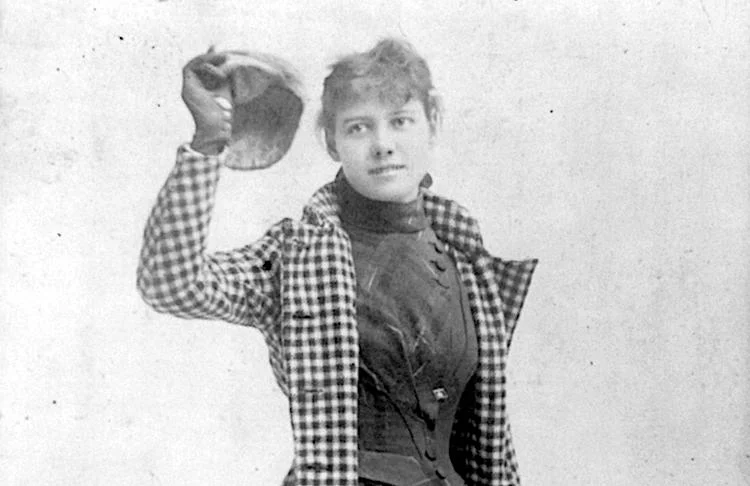
In 1887, a young woman named Nellie Bly faked insanity to gain entry to New York City’s notorious Women’s Lunatic Asylum on Blackwell’s Island (now known as Roosevelt Island). Just a few weeks earlier, she had sat in the offices of Joseph Pulitzer’s New York World newspaper and been given the assignment: feign mental illness, get committed, spend 10 days in the madhouse, and then report on her experience. The articles she published after she got out would catapult her to fame and land her the title of America’s first female investigative journalist.
Bly was born Elizabeth Jane Cochran on May 5, 1864. She grew up in rural Pennsylvania, where her father ran a relatively successful mill. When she was only 5 years old, her father died, leaving Bly, her mother and two older brothers in a precarious financial situation, according to the National Women’s History Museum. In a time when women had few financial opportunities, her mother’s primary option for supporting the family was to remarry – which she did. Bly enrolled in the Indiana Normal School (today, Indiana University of Pennsylvania) but was forced to drop out after just one semester, when her mother’s second marriage ended in divorce. There were no funds for schooling, and so Bly and her mother moved to Pittsburgh in 1885 to look for work.
There, Bly came across the Pittsburgh Dispatch article “What Girls are Good For,” which railed against women in the workforce and advocated for them to stay home and birth children. Outraged, Bly channeled her frustrations into a letter to the editor, opining that there should be more work opportunities for women, especially those responsible for supporting their families. Bly signed the letter “Lonely Orphan Girl.” George Madden, the editor of the Pittsburgh Dispatch, was reportedly so impressed he asked for the author to come forward, and soon offered Bly a full-time reporter position. She began using the pen name “Nellie Bly” – inspired by a popular song — as pseudonyms were common for women writers at the time.
As a journalist, Bly continued to focus on women’s issues, exposing unfair divorce laws and the harsh conditions faced by women and children at a copper cable factory (which she discovered by going undercover). When the factory complained, the paper backed down quickly (that’s according to a Library of Congress account) and relegated Bly to the women’s pages – work that she did not enjoy.
At only 21, Bly left the Pittsburgh Dispatch and its women’s articles behind, traveling to Mexico where she spent six months writing about the country, its people and its culture – which eventually became her first book, Six Months in Mexico.
By 1887, Bly was in New York City looking for a new paper to write for. According to the National Women’s History Museum, she was turned down by paper after paper, but determined as ever, she somehow talked her way in to see New York World editor Joseph Pulitzer (yes, that Pulitzer). She left with the mission to infiltrate the Women’s Lunatic Asylum.
Bly’s plan to get committed involved showing up at a boarding house and pretending not to know who she was or where she’d come from. Within a few days and a police-ordered mental evaluation, she found herself on a boat to Blackwell’s Island with a doctor’s note deeming her “insane.”
During 10 days at the asylum. Bly documented severe mistreatment of patients, including physical abuse, inadequate food and freezing temperatures. She also found that many of the women had been committed because they were poor, immigrants or unable to speak English.
At one point, she witnessed a German woman who did not speak English get committed because the staff were too lazy to get a translator.
“Here was a woman taken without her own consent from a free world to an asylum and there given no chance to prove her sanity. Confined most probably for life behind asylum bars, without even being told in her language the why and wherefore. Compare this with a criminal, who is given every chance to prove his innocence….Mrs. Schanz begged in German to know where she was, and pleaded for liberty. Her voice broken by sobs, she was led unheard out to us.”
After Bly was released (one of her colleagues came to her rescue) her exposé caused public outrage. Eventually the asylum was investigated – reforms were instituted, and funding was increased. Bly’s articles also had long-term impacts on the care provided for people with mental illness.
Bly’s reporting was groundbreaking but also reflected the fierce competition in the 1890s between William Randolph Heart’s New York Journal and Pulitzer’s New York World. The rivalry fueled “yellow journalism,” a style marked by sensational stories, and Bly’s work certainly helped sell papers.
By age 23, Bly was one of America’s most famous journalists. While other papers hired undercover “stunt girls,” Bly’s ability to infiltrate various spaces remained unmatched. She posed as a domestic employee, a chorus girl and an unwed mother, and in 1889 traveled around the world in just 72 days – a response to Jules Verne’s recently published Around the World in 80 Days – briefly setting a world record.
In 1894, at age 30, Bly married millionaire businessman Robert Seaman despite a 43-year age gap (though by most accounts their marriage was a happy one). After he died in 1903, she successfully ran his iron business until it folded in 1911 due to employee embezzlement.
Bly later returned to her journalistic roots during World War I. She reported from the frontlines in Eastern Europe for Hearst’s New York Evening Journal. After the war, she continued to write a popular column in New York until her death from pneumonia in 1922 at age 57. ◼️