

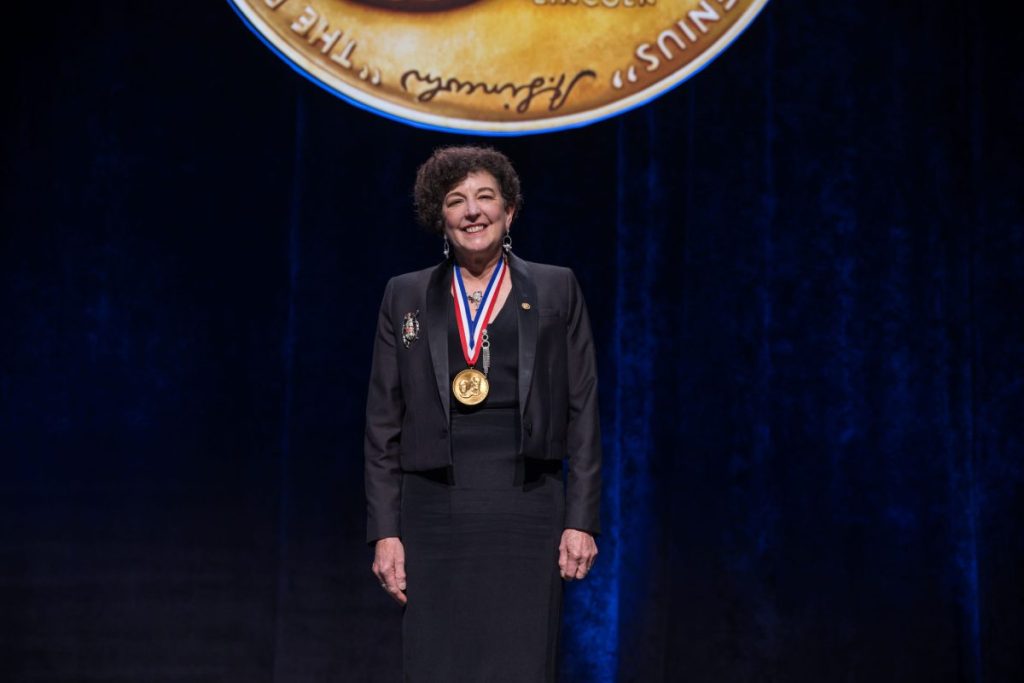
After 35 years of working in organic pest control, serial entrepreneur Pam Marrone is on a new mission to eradicate invasive species using alternatives to terrible chemicals. In particular, she’s on a quest for what she calls “the holy grail” – an eco-friendly herbicide that will zap out non-native weeds.
“We have the team that can really execute it,” says Marrone, whose 2-year-old startup, Invasive Species Corp., known as ISC, is already helping the state of California find a sustainable way to deal with golden mussels, which clog waterways and damage water treatment facilities. “There’s nobody doing exactly what we’re doing with invasive species.”
But it’s the product that specifically knocks out invasive weeds without damaging the environment that has the potential to be a blockbuster, Marrone says, especially as weeds have evolved to tolerate even harsh chemicals. In the U.S. alone, invasive weeds are responsible for over $30 billion in damages each year and cover 100 million acres, about the size of California. More startups are now in a hot race to develop bioherbicides – derived from natural materials, such as bacteria or fungi – but not many have made it to market, as the process is expensive and time-consuming.

And that’s where Marrone believes her new Davis, California-based company has an advantage. It has raised $3.25 million and identified several bio-based herbicide candidates that will be field-tested in the next year. That research will be funded in part by two products that ISC has already developed, Zequanox (which targets invasive mussels) and Piscamycin (which controls invasive fish). Plus, there’s Marrone herself, who was recently named to Forbes’ “50 Over 50: Innovation” list and inducted into the National Inventors Hall of Fame (she holds more than 400 patents). “We can do it faster than anybody,” she says. “Nobody is taking the approach that we’re taking.”
Solving Big Problems
When talking to Marrone, it’s hard not to get excited about agricultural/aquatic pest control – a topic this reporter, a longtime New York City dweller and former English major – doesn’t think about all that much. But Marrone, an entomologist by training who frequently wears insect-themed jewelry (today she’s wearing a butterfly necklace and earrings) can speedily and enthusiastically talk about invasive species and ways to control them.
“Asian citrus psyllid came in from China and spread citrus greening disease. Spotted winged drosophila invaded fresh berries,” she says, without skipping a beat. Weeds are considered a “pest” in agriculture as they compete with crops for water, nutrients and sunlights, leading to diminished yields. “The worst weed, Palmer pigweed, is ….resistant to all the chemical herbicides,” she says. “That’s why everybody’s trying to control it.”
Before ISC, Marrone had started her own organic pest-control company, Marrone Bio Innovations Inc., which she successfully took public in 2013. By 2020, the company’s stock price had dipped, and Marrone and another executive, Jim Boyd, left. They co-founded ISC after a three-year non-compete agreement expired. (Marrone Bio has since been acquired by Bioceres Crop Solutions Corp.)
In this 2018 video, we share the story of how Pam Marrone began her career in organic pest control. (Credit: Sue Williams)
Marrone serves as executive chair at ISC while Boyd is CEO, and a third former Marrone Bio executive, Amit Vasavada, is chief science officer. The team was able to get off to a fast start because they had already developed Zequanox, a natural bacterial formula that kills invasive zebra and quagga mussels, while at Marrone Bio – and they were able to take it with them to ISC as their base product.
Marrone says she decided to focus on invasive species after reading a 2023 UN report that found non-native plants and animals cost the global economy at least $423 billion each year. “It basically said everything we were thinking,” Marrone says. “Trillions of dollars of damage to date. It’s getting worse with climate change. And we don’t do a good job of managing them.”
Her current customers include utility companies that need to destroy invasive mussels in their cooling bays, and golf courses who want to clean out their irrigation pipes and ponds. ISC also has partnered with the U.S. Geological Survey “to save the whitefish, which are going extinct from the mussels destroying the Great Lakes,” Marrone says. “It’s just an amazing, impactful project.”
Looking Toward a Greener Future

The impetus for Marrone’s science-based work, as it has been throughout her long career, is to provide natural alternatives to dangerous chemicals, which is better for the environment – not to mention, human health. Glyphosate, a widely used herbicide, has been linked to increased rates of cancer, as has 2,4-D. Rotenone, used to kill invasive fish, is linked to Parkinson’s disease, as is Paraquat, another common herbicide.
A current challenge is doing that work while there are massive cuts to the Environmental Protection Agency under the Trump administration. And earlier this year, DOGE targeted the U.S. Geological Survey’s aquatic labs for budget cuts, although it has reversed course in some areas. “I think they’ve been educated that invasive species are so destructive to commerce,” Marrone says.
While “I was worried about our grants being affected,” she adds, ISC was recently approved for a U.S. Department of Agriculture grant testing Zequanox on invasive snails. “So far, we’ve been lucky,” she says.
As she looks toward the future, Marrone says her 9-employee company’s focus will be on developing the eco-friendly herbicide, which so few have been able to crack. “It’s considered technically challenging to get to the price point and the performance of chemical weed killers,” she says. “Now, with the new tools of AI, machine learning and precision fermentation, we believe we can.”
And retirement, for anyone who was wondering, is out of the question. Marrone notes her mother, a lifelong naturalist, turned 99 in the past year. “I have a ways to go yet,” she says. “There’s such big problems to solve and I can help do it.” ◼️