

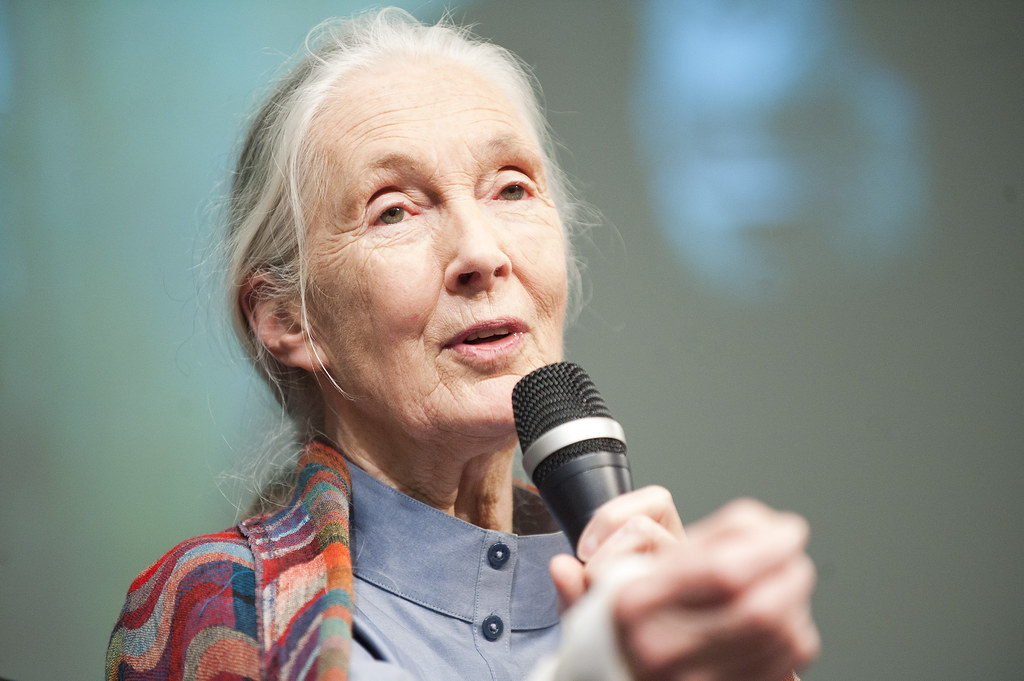
It can’t be said that Jane Goodall’s death this week – peacefully, in her sleep, while on a speaking tour – was entirely unexpected. She was, after all, 91 and had already (for decades, even) cemented her status as a rock-star scientist and planet advocate extraordinaire.
But somehow, many of us never thought we’d lose this unexpected crusader with the small stature, quiet demeanor and simple ponytail. Her groundbreaking work, first with chimpanzees in the 1960s and much later, on the climate crisis, inspired generations of women to explore careers in science. It inspired generations of women, period.
Young women today may not realize how remarkable it was that Goodall, then just in her 20s, headed into the African jungle to study chimps, living with them for months and observing their behavior. When she noticed one chimp – who she nicknamed David Greybeard – use a stalk of grass to fish termites out of a mound of dirt, it was a scientific revelation. “It was obvious that he was actually using a grass stem as a tool,” she later wrote, a challenge to the assumption that humans were the only tool-making animals.

A word that might describe Goodall is “unconventional.” She chose a non-traditional career path at a time when the majority of women in the U.K., her home country, were housewives. Not yet a trained scientist, her methods of study were unusual – and one might argue, perhaps the sort of value a young woman might bring to a male-heavy field. Rather than number the chimps, she gave them names: Flo, Fifi, Mr. McGregor. It made a difference, she asserted.
“Breaking down this perceived sharp line between us and other creatures,” Goodall told Scientific American in 2010, “helped people understand that we are part of and not separated from the animal kingdom, and that has opened the way to having respect for the other amazing beings with whom we share the planet.”
Despite her significant contributions and early notoriety, Goodall batted sexism – she endured comments about her blond hair and “nice legs” – but persevered by focusing on her work and scientific data.
“I had to work 10 times harder than the average man just to get the same level of recognition,” Goodall told Rolling Stone in 2020. “But once I had made a name for myself, I let the data speak for me.”
In her later years, Goodall worked tirelessly to protect nature. Her Jane Goodall Institute, founded in 1977, continues to protect chimps but has expanded over the years to champion human rights, animal welfare and environmental conservation.
While Goodall has passed on, her legacy certainly hasn’t – and her ability to inspire women in science to fight battles might be more important than ever. Her approach could be summed up as less anger, more soft touch. More hope, more commitment, even as the world, in some cases, literally burns around us. This is not the time to give up, she reminded us. “I have days when I feel like not getting up,” she told the Guardian in 2021, “but it doesn’t last long. I guess because I’m obstinate.” She continued: “I’m not going to give in. I’ll die fighting, that’s for sure.”
And she did. One of her last appearances was just a week ago, at New York Climate Week, where she reminded people: The climate crisis is the greatest challenge of our time—but if we act with courage and hope, change is still possible.
Thank you, Jane. ◼️