

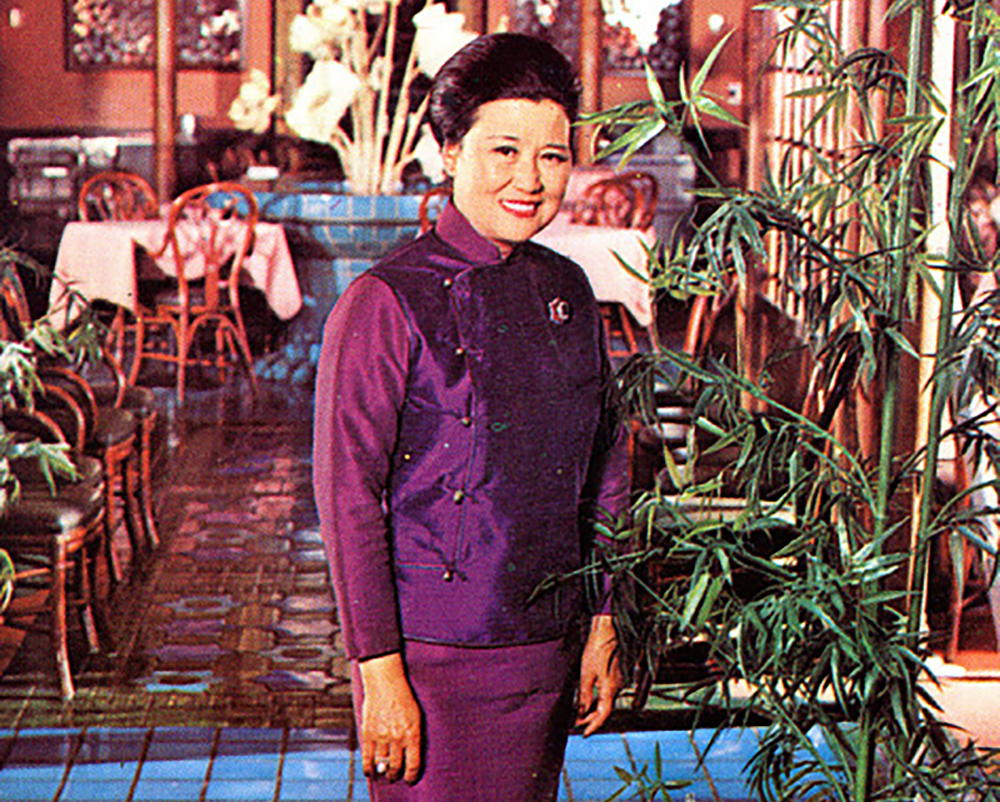
On any given night in 1960s San Francisco, you could walk into the upscale dining room of The Mandarin restaurant, and hear the sizzle of pan-fried pot stickers, and smell signature dishes like beggar’s chicken or peppery Sichuan eggplant, all of which most Americans hadn’t seen before. And in the center of it all, holding court – often amid celebrity guests – would be the owner, Cecilia Chiang. “My grandmother was a quintessential front-of-house host,” says Siena Chiang. “They called her Madame Chiang, and she reveled in having the perfect outfit and creating a warm environment and welcoming people of all stripes.”
But behind the perfect hostess greeting, Madame Chiang had a backstory worthy of a Hollywood movie. Born to a wealthy family near Shanghai, she and her sister escaped the Japanese invasion on foot, eventually immigrating to the U.S. during the Communist Revolution. She opened The Mandarin, introducing diners to Chinese food beyond the stereotypical dishes of chop suey, egg foo young and chow mein.
The episode also features Paul Freedman, author of “Ten Restaurants That Changed America” – one of which was The Mandarin.
Check out the entire Seasoned project, with more episodes rolling out in the weeks and months ahead.
More From This Series
Seasoned, Episode 1 – MFK Fisher
Our 6-episode podcast kicks off with the California writer who invented the food memoir. Long before Anthony Bourdain, there was a woman who taught us how to enjoy food, drink and life.
Seasoned, Episode 3 – Lena Richard
Down in the Big Easy, a Creole chef experiments with bold flavors and becomes a forebearer of today’s multihyphenate food personality, even as her life is cut short.
COLLEEN DEBAISE: Hi there. I'm Colleen DeBaise, and welcome to The Story Exchange. Today I'm joined by food historian Victoria Flexner.
VICTORIA FLEXNER: Hey, Colleen!
COLLEEN: Hey, Vic. We're continuing our conversation about the women who helped define American food culture.
VICTORIA: Yes. We're looking at the women, some of whose names you may not be too familiar with, but who defined the ways in which we write about food, how we eat, how we cook, and how we talk about food.
COLLEEN: In today's episode, we're taking you to 1960s San Francisco, and inside the legendary Chinese restaurant, The Mandarin.
VICTORIA: On any given night, you could walk into its upscale dining room and hear the sizzle of pan-fried potstickers and smell signature dishes like smoked tea duck or beggar's chicken or peppery Szechuan eggplant.
COLLEEN: Mm! And in the center of it all, holding court, often amid celebrity guests, would be the owner, Cecilia Chiang.
SIENA CHIANG: My grandmother was the quintessential front of house host. They called her Madame Chiang, and she reveled in having the perfect outfit and creating a warm environment and welcoming people of all stripes.
VICTORIA: That's Siena Chiang.
SIENA: And I am Cecilia Chiang's granddaughter.
COLLEEN: And Vic, you sat down with Siena recently to talk about how her grandmother, who passed away five years ago at age 100, famously brought authentic Chinese cuisine to America.
VICTORIA: Yeah, and Cecilia Chiang wasn't just a restaurateur. She also served as a mentor to numerous chefs and food personalities, like James Beard and Julia Child, teaching them about the diversity and complexity of Chinese cuisine.
COLLEEN: Yeah. Here's Alice Waters of Chez Panisse in California.
ALICE WATERS: Cecilia Chiang is the Julia Child of Chinese food in America.
VICTORIA: And I also spoke to Siena about her grandmother's truly remarkable backstory. Born to a wealthy family near Shanghai, she grew up in Beijing.
SIENA: In a 52-room house, mansion.
VICTORIA: When the Japanese invaded in 1937, Cecilia fled her home, traveling over 700 miles on foot to unoccupied China in the south. And when the Communist Party seized power in 1949, she left the country altogether.
COLLEEN: Yeah, it's an incredible story. But before we dive into Cecilia's background, let's talk a bit about the history of Chinese food in America.
VICTORIA: Chinese cuisine is really entwined in our culture. I think one could argue that it's as American as hamburgers or apple pie! The first Chinese restaurant in the U.S. opened way back in 1849, and I can't think of many places I've been to in America that don't have a Chinese restaurant or takeout spot.
PAUL FREEDMAN: There are, what, 35,000 or so of them in the U.S., more than McDonald's and KFC combined. And the American infatuation with Chinese food goes back to the late 19th century.
COLLEEN: That's Paul Freedman.
PAUL: I teach history at Yale.
COLLEEN: Paul is also the author of “Ten Restaurants That Changed America,” and he included The Mandarin on that list.
PAUL: It introduced to many people, including myself when I was in graduate school at Berkeley in the 1970s, Northern Chinese cuisine, Chinese cuisine that wasn't Cantonese, Chinese cuisine that had a lot of spice, like the Sichuan region, dishes like potstickers or hot and sour soup.
COLLEEN: Here's a clip we have of Cecilia herself talking about her restaurant.
CECILIA: I don't want to do something other restaurants have. That's why my menu, you cannot find any chop suey, egg foo young, and chow mein!
COLLEEN: She's saying in her restaurant, she didn't want her chefs making stereotypical dishes like chop suey, egg foo young and chow mein.
VICTORIA (FROM TAPE): What is chop suey?
PAUL: So chop suey was the dish that really made Chinese restaurants, from the beginning of what was called, at the time, the chop suey craze, 1897, until it started to fade out in the 1960s.
COLLEEN: Yeah, I remember when I was growing up, supermarkets used to sell these chop suey kits, kind of like the old El Paso taco kits you can find in grocery stores today. And this was really my introduction to Chinese food. I think it was for many Americans.
PAUL: People of my age had it in school. I mean, it was ubiquitous. We had either chop suey or chow mein. The thing that Americans really didn't get, or didn't bother to understand until really well into the 20th century, was stir-frying, because this was so alien to Western European ways of cooking, that gives so much of Chinese food its distinctive taste.
VICTORIA (FROM TAPE): It's almost like a style, a method of cooking from China, that was very different from Western cooking--I suppose, American, European. You're chopping things into smaller pieces so that they can cook faster with more fuel efficiency. But it's interesting that that then becomes emblematic of what Americans were sort of thinking of as the entire culinary repertoire, when really it's just a style of preparation.
PAUL: Yeah. I mean, you could argue that General Tso's chicken is the chop suey of the late 20th and early 21st century. It's a dish that really doesn't exist in China.
VICTORIA: And it's important to note here that this is something we see again and again with immigrant cuisine in America.
COLLEEN: Hm. How so?
VICTORIA: A new cuisine is introduced, and aspects of it are Americanized, converted into a format that will appeal to American palates and feel somehow familiar.
COLLEEN: Yeah, like Tex-Mex somehow evolving out of Mexican food.
VICTORIA: Exactly. Or the California roll with Japanese food.
COLLEEN: Chicken parm with Italian food.
VICTORIA: We could go on and on with these. But see, this is what made The Mandarin so important, and what makes Cecilia Chiang such an icon. She decided she wasn't just going to serve chop suey versions of Chinese food. She was going to serve the real deal.
SIENA: She took a lot of pride in introducing people to what she knew to be regional, authentic, high-end, upscale cuisine, like the cuisine that she ate, that her, you know, trained chefs cooked in her childhood.
VICTORIA: That's Siena Chiang again.
SIENA: You know, my grandmother was a little bit of an elite person. And so I do think that there was also a bit of a separation between the food of, kind of, the immigrants who came to build the railroads, and the type of food and the type of experience she had known, which I always find just really important to share. Because there are often folks who want to talk about her as a role model, or the legacy, and she was this immigrant…And absolutely, that's totally true…and she had a slightly different experience than the kind of mass immigration stories that we know from that time period from China.
VICTORIA (FROM TAPE): And I feel like one of your grandmother's legacies is that she showed Americans that Chinese food is not just like, some cheap meal; this is haute cuisine.
SIENA: I think that there was a little bit of, like, “I'm going to show them, they're going to take me seriously. They're going to take this food seriously,” as a proxy for taking, you know, Chinese culture seriously.
PAUL: She also had things like beggar's chicken, just cooked in a clay pot, which you had to order a day or two in advance.
CECILIA: I think this is one of the most popular dishes in The Mandarin.
LAURENCE JOSSEL: Now, I've looked at the recipe and the recipe is at least two hours in the oven, right?
VICTORIA: That's San Francisco chef Laurence Jossel cooking beggar's chicken with Cecilia in 2016.
LAURENCE: A lot of the dish is the presentation at the table, right? So you crack at the table?
CECILIA: Yeah, you crack on the table.
LAURENCE: Right.
VICTORIA: It was a favorite dish of James Beard.
LAURENCE: So first thing is one teaspoon of five spice… Oyster sauce… Let's marinate the chicken. So now you think we're ready to make the stuffing?
CECILIA: Yeah.
LAURENCE: These are the shiitake…water chestnuts…green onion…OK, and then ham.
VICTORIA: So what they're doing is taking this beautifully marinated stuffed chicken, and then wrapping giant lotus leaves around it, and then completely encasing it in a shell of clay.
CECILIA: …in the clay.
LAURENCE: In the clay. But what's important is to keep it airtight, huh?
VICTORIA: And back in the days of The Mandarin, this would be carried over to the table where a guest would then be given a special hammer to dramatically crack the clay shell open.
CECILIA: You know how to crack it, do you?
LAURENCE: I'm going to try. Let's see.
CECILIA: (laughter) Wow.
LAURENCE: OK!
CECILIA: That looks like the clay is perfect. See the heat?
LAURENCE: It's very hot.
CECILIA: Yeah, very hot.
LAURENCE: It smells delicious.
PAUL: She was not so much interested in Americanizing Chinese food, or even in authenticity, but just of giving people a sense of the tradition of a world that was lost.
VICTORIA: After the break…
CECILIA: That's a really hard trip. Took us from Beijing to Chongqing, five and a half months.
VICTORIA: Cecilia flees her childhood home in Beijing to escape the Japanese army sweeping south through China.
COLLEEN: We'll be right back.
COMMERCIAL: The Story Exchange is an award-winning, nonprofit media platform that elevates women's voices and achievements. If you like what you're listening to in our series on culinary pioneers, check out our episode on famous food writer MFK Fisher.
ANNE ZIMMERMAN: She's with James Beard. She's with Julia Child. She's the godmother of the American wine world and food world.
COMMERCIAL: And stay tuned for more episodes to come on American food pioneers Lena Richard and Edna Lewis.
COLLEEN: Welcome back. I'm here with food historian Victoria Flexner talking about the legendary restaurateur Cecilia Chiang.
VICTORIA: Her San Francisco restaurant, The Mandarin, redefined Chinese food for Americans. And I think to better understand the legacy of her work, we need to look at the world that she came from.
SIENA: She, by all accounts, grew up in a very privileged, kind of aristocratic, for that time and place, life.
VICTORIA: Cecilia and her 12 siblings…
SIENA: …grew up in a 52-room house mansion. They had help. They had chefs who made delicious meals.
VICTORIA: But then in 1937, when Cecilia was in college, the Japanese invaded northern China. It was the beginning of World War II in Asia.
NEWSREEL: By 1937, Japan was ready for the next step in its plan of world conquest to bring the rest of China under Japanese rule.
VICTORIA: The Japanese military easily defeated the Chinese Nationalist Army and swept south.
NEWSREEL: This is the first mass bombing from the air of a helpless civilian population.
VICTORIA: It was a time of terror for the Chinese in their path. Literally hundreds of thousands of civilians were massacred, tortured and starved.
CECILIA: Problem with all families, we didn't have enough food, everything on ration, no rice. We cannot get anything.
VICTORIA: That's Cecilia speaking in the 2016 documentary series, “The Kitchen Wisdom of Cecilia Chiang.”
CECILIA: In January 1942, my number five sister and I, we decided we really should leave. We all cried because we don't know when we're going to see them again. And also very scared.
VICTORIA: Like thousands of others, the Chiang sisters made their way across the country to the city of Chongqing in southwest China, which was not under Japanese control.
SIENA: They actually left on a train, is my understanding, but then at some point the train line ended. And so she walked.
CECILIA: We walk night time, and day time, we try to find a place to rest. And the Japanese airplane was flying really low and shooting all the students all the way. Very hard to get some decent food because from village to village. And we didn't have a map. We have to ask the people in the village, what is the next village, and how far it is from here to Chongqing?
SIENA: Some of the stuff that I know around this period is not stuff she ever talked directly to me about. I have a sense that it was a long, long time ago. By the time she and I had our own relationship, it would have been 70 years before that time. But also really painful, you know, traumatic memories of violent, you know, upsetting things that the Japanese did and did to classmates of hers and people that she knew.
CECILIA: That's a really hard trip. Took us from Beijing to Chongqing five and a half months.
VICTORIA (FROM TAPE): How do you think it may be informed aspects of her personality, in the way she approached her career and her life and her work?
SIENA: It's a great question. And she definitely never hid anything, her history. But I do think that people who go through things like that… I think it's hard for a lot of us to imagine. She lived very in the moment. She was a very present person and she was a very, like, “Don't complain and just make the most of things.”
VICTORIA: In Chongqing, Cecilia met the man who would become her husband.
SIENA: I think they were there for a little while. They started to have their relationship and their family there.
VICTORIA: But just as World War II ended, China erupted in civil war between the American-backed nationalist government and the ever-growing armies of the Chinese Communist Party, led by Mao Zedong. By 1948, the communists had won control of North China and began to move south. They faced little resistance.
*Mao Zedong speaks as a crowd applauds*
VICTORIA: That's Mao declaring victory a year later in 1949. Like thousands of other wealthy families who feared persecution under communist rule, Cecilia and her husband made the decision to leave the country.
SIENA: It was very much a last plane out sort of narrative, a last-ditch effort, “we just made it out,” narrative and feeling.
VICTORIA: They took their two children to Tokyo and began a new life.
SIENA: They invested in and opened a Chinese restaurant in Tokyo called The Forbidden City.
VICTORIA: But after a few years, Cecilia made a fateful decision. She headed to California to support her sister who had moved there and whose husband had recently died. Cecilia's own husband chose to stay in Japan.
SIENA: I know my grandmother and I think she was a little bit restless and maybe didn't really want to be in Japan.
VICTORIA: Pretty understandable considering what she and her sister went through during the Japanese invasion. And when she got to San Francisco…
SIENA: …she ended up staying there and never going back.
CECILIA: You know, you say you heard so much about the United States. You know, also you see a lot of movies about the United States… You get here, not quite the same!
VICTORIA: There's a famous story of how Cecilia came to open The Mandarin.
VICTORIA (FROM TAPE): Your grandma's walking down the street. She runs into two people she knows from China, not from Japan, right?
SIENA: Yeah.
VICTORIA (FROM TAPE): And what ensues?
SIENA: OK, this is going to be a timeout moment. I'm going to tell you the real story.
VICTORIA (FROM TAPE): OK. (laughter)
SIENA: Unless you want me to just tell you the known story--
VICTORIA (FROM TAPE): Oh no!
SIENA: --I'm going to tell you the real story. I figured! I figured! OK. The story that everyone knows is that they're walking down the street outside of Chinatown and they run into some people that they'd known back in China and that those folks were like, “Oh, my gosh, we're so excited that we ran into you. We are in the process of trying to open a restaurant and trying to negotiate with the landlord. And you speak way better English than we do. Could you please just come help us? Just a one time favor.”
VICTORIA (FROM TAPE): Just like, a translation.
SIENA: Just a translation favor. Right. The version for the Spielberg movie. Ran into them on the street, goes to a meeting, negotiates with the landlord, she signed the papers--which doesn't quite make sense, if she’s doing them a translation favor. So I think, yeah, the real version is she becomes interested in being a part of this venture, puts up money and then for some reason or another, those other folks back out. And yeah, she becomes responsible for opening this business.
COLLEEN: OK, so the legend was that she was kind of scammed, but actually she was savvy enough to see the possibility.
VICTORIA: That's exactly right.
SIENA: So in these letters that she's sending back and forth to my grandfather, it becomes clear to me that, no, there was actually like a little bit of intention behind the possibility of opening a restaurant.
VICTORIA: The Mandarin opened its doors in 1961, and it wasn't in Chinatown.
SIENA: She is kind of an insider-outsider. The Chinese immigrants that had settled in San Francisco at that time were from a very different part of China. They're from a different class. They spoke Cantonese. My grandmother and her family spoke Mandarin because they were from the north.
VICTORIA: Hence its name, The Mandarin.
PAUL: She was quite successful, as you say, for kind of contingent and even accidental reasons.
VICTORIA: That's Paul Freedman again, the historian. We talked about the rise of The Mandarin's popularity and how it shifted dramatically when a journalist named Herb Cain came to visit.
PAUL: Herb Cain was, on the one hand, a gossip columnist in the era when gossip columnists were at the height of their powers. But he was more of an intellectual and not just a follower of stars and socialites. And he went to the restaurant and in his column, said, “This is the best Chinese food I've had this side of the Pacific.” And the next day, you know, there was a line out the door.
VICTORIA: The restaurant moved to a new and bigger location.
PAUL: It was in a restored space in San Francisco's Ghirardelli Center, which had been a chocolate factory; one of the first kind of examples of reusing industrial buildings. It was also elegant, and very deliberately. Cecilia Chiang said that she didn't want dragons. She didn't want red and gold decoration. It was modern. It had works of contemporary art.
VICTORIA: We all know what follows a hot restaurant review. Everyone wants a table. The phone is ringing off the hook. Lines are out the door. And in short order, the rich and the famous become clientele.
CECILIA: We have presidents like Reagan, Bush and also Kennedy families. Rock singers, models, fashion designers and the movie stars. Every time when John Lennon came to town, that “must” stop is The Mandarin.
SIENA: There's a story about the members of Jefferson Airplane coming, the rock stars showing up. And at that time, San Francisco was a little bit of a conservative, snobby place. Folks like that who were coming on tour were not being taken seriously, or maybe couldn't get into the black tie or, you know, tie and jacket type of establishment; I think out of snobbery, and out of, like, “We don't know if these people can pay.” And my grandmother was like, “I'm going to trust these folks.”
VICTORIA: The members of Jefferson Airplane became fast friends of Madame Chiang's.
SIENA: She was a curious, inquisitive, pretty open-minded person. She had a way of making people feel seen and special.
VICTORIA: Cecilia didn't just host the Hollywood stars at her restaurant. She also taught culinary stars like James Beard and Julia Child how to cook Chinese food. Well into her 90s, she mentored other Bay Area chefs and restaurateurs, like her good friend Alice Waters.
ALICE: Going into your restaurant, it felt like going into a whole other world…
SIENA: So even though she was doing regional Chinese food, she was in the mix with Alice, who was young, in her—Alice would have been in her twenties. Alice and my grandmother had a beautiful, intergenerational friendship, that was definitely mentorship, and they traveled together. And yeah, were women running restaurants at the same time.
VICTORIA: As Siena and I were wrapping up our conversation, I asked her about how she sees Chinese food fitting into this larger story of American food.
SIENA: American food is…I have a phrase that I'm trying to popularize, which is “second gen food.” Like, there's a lot of people who have parents who are immigrants, who are melding their experience of growing up in America, being exposed to other cultures, with their parents’ Indian background or Chinese background or, you know, anywhere. And I think my grandmother was on the forefront of doing that.
SIENA: My grandmother sold the restaurant in the early 90s, and it closed in the mid-2000s.
VICTORIA: And one last thing.
SIENA: I guess we haven't talked about P.F. Chang's, which was my dad's endeavor. He'll be happy if he listens to this for me to say that.
VICTORIA: Siena's father, Cecilia's son, Philip, would go on to open P.F. Chang's, a fast, casual Chinese restaurant chain, of which there are hundreds of locations across the globe today.
SIENA: She laid the groundwork for my dad to definitely do that.
VICTORIA: But back to what Cecilia was doing.
SIENA: She was trying to hold on to that, where she was from. And of course, bringing it into a new context where you have access to different ingredients, where you're interacting with new types of people; it morphs and it shifts and it becomes diasporic food.
CECILIA: I do something nobody else going to do it. A lot of my famous dishes, like minced squab, Peking duck, smoked tea duck, make me, you know, successful.
COLLEEN: Well, I really wish I could order some beggar's chicken right now.
VICTORIA: Yeah, I've already started googling where I can buy edible clay and lotus leaves to make it at home. Do I need edible clay…?
COLLEEN: Join us next time as we make our way from the West Coast down to Louisiana…
VICTORIA: …to New Orleans…
COLLEEN: …where a woman named Lena Richard became a famous Creole chef who wrote cookbooks, opened a cooking school, had numerous restaurants…
VICTORIA: And she became the first Black woman way back in 1951 to have a cooking show on TV in America.
COLLEEN: We thank Paul Freedman and especially Siena Chiang for sharing their thoughts on Cecilia Chiang.
VICTORIA: And we thank you for listening. This has been The Story Exchange. Join us next time to hear more stories about innovative and inspirational women doing the things you'd never dream of. Or maybe you would. If you liked this podcast, tell your friends about us and feel free to share it on social media. It helps other people find the show and visit our website at thestoryexchange.org, where you're going to find news, videos and tips for entrepreneurial women.
COLLEEN: And we'd love to hear from you. Drop us a line at info at thestoryexchange.org or find us on Facebook, Instagram, LinkedIn and Bluesky. I'm Colleen DeBaise, reporting by Victoria Flexner. Sound editing provided by Nusha Balyan. Production coordinator is Noel Flego. Executive producers are Sue Williams and Victoria Wong. Our mixer is Pat Donoghue. Recorded at Cutting Room Studios in New York City.
VICTORIA: And our thanks to Charlie Pinsky for very kindly letting us use audio from his series “The Kitchen Wisdom of Cecilia Chiang.”