

NY Sun Works executive director Manuela Zamora. (Credit: NY Sun Works)
Meet the Nonprofit Leader Who’s Teaching Kids About Hydroponic Farming
At NY Sun Works, Bolivia-born Manuela Zamora has pioneered a hands-on approach to train the next generation of climate scientists and farmers.

If one word can describe Manuela Zamora, it is energy.
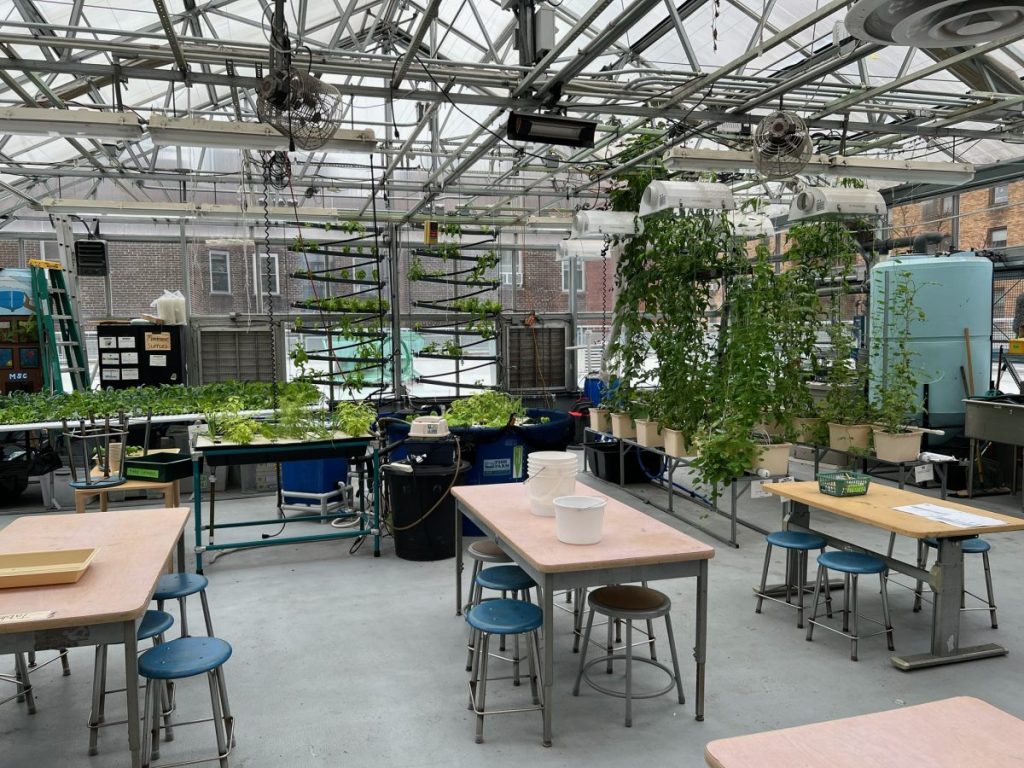
It helped her build the climate education nonprofit, NY Sun Works, which creates hydroponic farming classrooms, teaching students how to grow plants and crops in nutrient-rich water rather than soil. The nonprofit has grown rapidly in recent years, fueled by rising interest in sustainability and hands-on science education, but also Zamora’s experience and emphasis on partnerships.
“This is an excellent way to talk about sustainability science,” she said. Students who may be future climate leaders are introduced to”fantastic new technology, which is not only efficient, but also so appealing to look at, to touch. It’s like going to a museum, and doing so, it really fits perfectly well with the hands-on approach, project-based education.”
Zamora’s leadership skills started in Bolivia, her native country. Her first job was in the Office of the First Lady of Bolivia before founding the nonprofit, Fundacion Carmen, creating the project El Dorado: The Route of Fair Trade, which provided business training for low-income women artisans throughout the country.
This gave her the building blocks needed for NY Sun Works. She learned about the environmental impact industrialized nations have on developing nations’ resources, and saw what happens when NGOs come to countries like Bolivia, without taking the time to research or understand the communities.
In 2003, Zamora, her husband, and two young children moved to New York, where she got involved in the PTA at her eldest’s school. A few years later, she was looking for ways to teach children about sustainability when she visited Dr. Ted Caplow, NY Sun Works’ founder, at his science barge, a floating urban farm on the Hudson. Built on a 115-foot steel deck, the science barge was able to grow cucumbers, tomatoes, bell peppers and lettuce. It even had a section for aquaponics, where catfish, tilapia and oysters were harvested.
Caplow quickly noticed Zamora’s interest and realized she could help develop a plan to create educational greenhouses. Zamora rolled up her sleeves and opened one on the rooftop of her son’s school. She eventually became NY Sun Works’ executive director in 2012
“Manuela was a spark from day one,” said Caplow, who now serves as NY Sun Works’ chair. “She was enthusiastic, friendly and serious about making things happen. She had experience organizing nonprofit programs in her prior career, so she pursued that first greenhouse with confidence and determination. She knew it could be done.”
Today, Zamora has led NY Sun Works into nearly 400 schools in the New York City area and has even expanded to Birmingham, Alabama. Curricula for all 12 grade levels have been created, and hundreds of teachers have been trained as climate educators. Education leaders nationwide have noticed, including former Secretary of Education, Miguel Cardona, who visited a hydroponic classroom in 2022
“Manuela has worked harder, longer and with more consistent determination than anyone else,” said Caplow. “Most important, through it all, she has maintained a positive, buoyant and creative approach to every interaction.”
For her part, Zamora believes the success of NY Sun Works comes down to relationships. She still remembers NGOs in Bolivia that understand little about the country’s communities. As a result, she believes partnerships with school districts or community-based organizations is key.
“We’re going to work together so it fits your community,” Zamora says, explaining how NY Sun Works first works with schools to understand challenges like locating funds and grants, especially difficult when climate science education is only mandated in two states. “In big city school districts like NYC, the sheer size and complexity of the system can be challenging, but we have found that our principals and teachers are the most effective advocates for their school communities.”
This is also how NY Sun Works partnered with Birmingham City Schools. Amanda Storey, executive director of the Jones Valley Teaching Farms, which generally brings outdoor farms to Birmingham school campuses, saw potential for both her organization and Zamora’s.
“When I saw what they were doing and heard Manuela talk about it,” Storey explained, “it immediately made me start to think that …we could partner with NY Sun Works and expand inside classrooms. I pitched them on that, and just said, ‘if we could go and get it funded, would you be willing to expand to Birmingham?’”
The answer was yes all around, and now eight Birmingham schools will see hydroponic classrooms this September.
Despite its achievements, NY Sun Works has new challenges, including the Trump administration’s discarding of environmental regulations and the dismantling of the Department of Education. But Zamora remains optimistic.
“It remains to be seen how it will impact funding directly,” she said. “But I think in terms of interest in the program, it will continue, it may even grow. It’s science education in general, but really bringing the joy of learning to the classroom, bringing that connectivity to the students. I think our program will become even more important and relevant than ever before.” ◼️
Know a trailblazing woman scientist? Nominate her for our ‘Cutting-Edge Women In Science‘ list.