
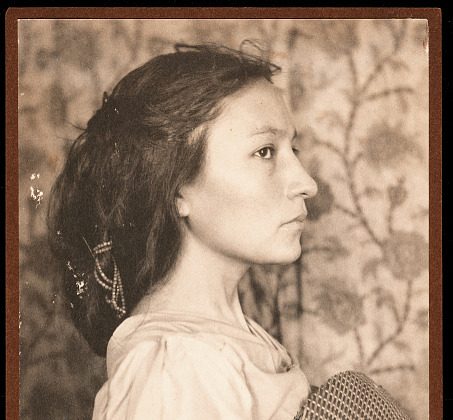
Zitkala-Sa, photographed by Gertrude Kasebier 1898. (Credit: Courtesy of National Museum of American History, Smithsonian Institution)
She Fought for Her People’s Rights – And to Safeguard Native American Culture
Zitkála-Šá was a prolific writer and activist who co-founded the National Council of American Indians. And she penned the first ever Native opera.

Editor’s Note: In honor of Women’s History Month, we’re sharing profiles of remarkable female activists from American history we think you should know (if you don’t already).
“I was a wild little girl of seven. Loosely clad in a slip of brown buckskin, and light-footed with a pair of soft moccasins on my feet, I was as free as the wind that blew my hair, and no less spirited than a bounding deer.”
– Zitkála-Šá, Impressions of an Indian Childhood
Zitkála-Šá was born in 1876 on the Yankton Sioux Reservation in what was then the Dakota Territory. Zitkála-Šá remembered her early years on the reservation fondly. She would later write of the simple breakfasts she ate with her mother by the fire, the sweet roots she and her playmates would dig up as snacks, the river that ran near her wigwam.
When she was just 8 years old, Christian missionaries from further east arrived in her village, with the purpose of recruiting Indigenous children and bringing them to the White’s Indiana Manual Labor Institute. The boarding school’s mission was to “civilize” Native American children — but in reality the institute worked to sever the children from their own language, tradition, culture and identity. Zitkála-Šá was one of the children recruited and she would go on to spend three years at the institute.
When Zitkála-Šá emerged on the other side of her time away at White’s Indiana Manual Labor Institute, where she was given the white name Gertrude Simmons, she found herself torn between two worlds. She wrote in her essay, “The School Days of an Indian Girl,” published in 1900 in the Atlantic Monthly,
“After my first three years of school, I roamed again in the Western country through four strange summers. During this time I seemed to hang in the heart of chaos, beyond the touch or voice of human aid…Even nature seemed to have no place for me. I was neither a wee girl nor a tall one; neither a wild Indian nor a tame one. This deplorable situation was the effect of my brief course in the East.”
Despite the cultural separation she endured at school, Zitkála-Šá excelled academically. She learned English, wrote beautifully, won multiple orator competitions, and also became a talented violinist. She briefly attended Earlham College in Indiana – where she began to collect stories from a number of different Indigenous tribes and translate them into English for children to read. She went on to study violin at the prestigious New England Conservatory of Music in Boston. She taught music for a period at the Carlisle Indian Industrial School in Pennsylvania, but ultimately, as she wrote in some of her published articles, she grew disillusioned with the institution’s strict assimilationist policies and left.

After her time at the conservatory, her writing career reached new heights as her work was published to a national audience. Starting in 1900, she wrote articles for the Atlantic Monthly, as well as Harper’s Monthly, where she revealed the systemic abuse and deracination experienced by Indigenous children through their forced education in Native boarding schools.
But it was her 1923 article, “Oklahoma’s Poor Rich Indians: An Orgy of Graft and Exploitation of the Five Civilized Tribes, Legalized Robbery,” which had the most immediate political impact. The piece, which exposed American corporations that had been robbing, defrauding and even murdering Native peoples (particularly the Osage) for the oil that had recently been discovered on their lands. Zitkála-Šá’s article played a part in influencing Congress to pass the Indian Reorganization Act of 1934, which aimed to reverse land allotment policies and promote Native American self-governance.
In 1916, Zitkála-Šá and her family relocated to Washington, D.C., when she became the national secretary for the Society of American Indians. From her new post in Washington, Zitkála-Šá advocated on behalf of Indigenous students and criticized the abuses they endured. She began to lecture nationwide to bring more awareness to the complexities of tribal identity in 20th century America. In the 1920s, she successfully helped lobby for citizenship rights for all Native peoples, granted when the government passed the Indian Citizenship Act in 1924. Just two years later in 1926, she helped to found the National Council of American Indians, the precursor to the National Congress of American Indians, which is still active today and advocates for Native rights.
Zitkála-Šá was a tireless activist, but she was also a prolific writer and artist. Though her activism often directed her focus away from music, Zitkála-Šá still found time to write an opera. The Sun Dance Opera was the first opera written by an Indigenous woman in America – and its story centered around the sacred Sun Dance ceremony (which had been outlawed since 1904). The opera premiered on Broadway in New York City in 1938, just a few weeks after Zitkála-Šá passed away.
In recent years Zitkála-Šá’s incredible legacy has received renewed attention with the creation of the Smithsonian American Women’s History Museum in 2020, where many images of her are housed — and with her memorialization on a 2024 quarter. ◾