
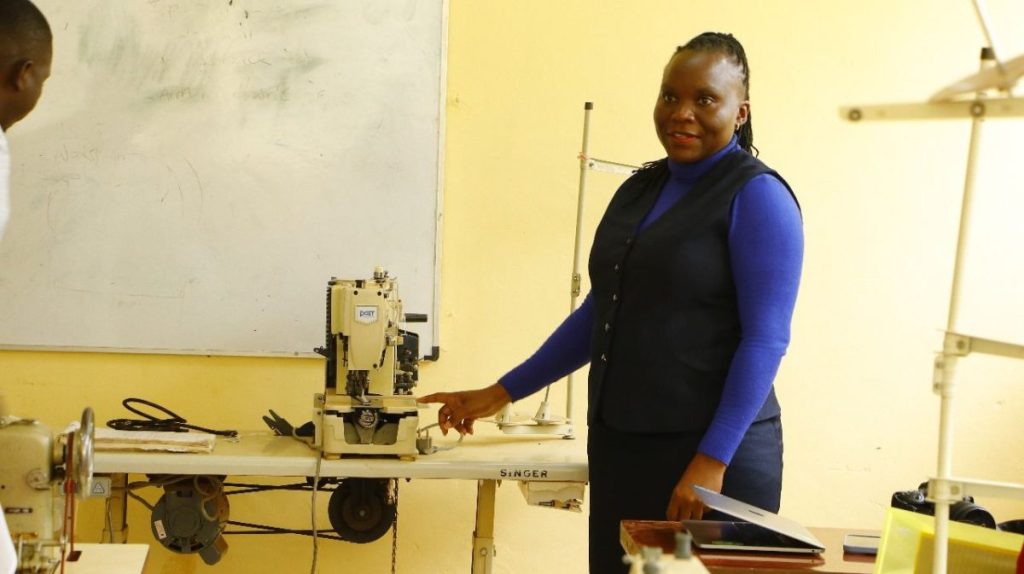
A few years ago, Dr. Maureen Adoyo at Rongo University in southwestern Kenya was tasked with answering these questions: Why were there so few women in the university’s study body? And what, if anything, could be done about it?
To understand the problem, Adoyo had to go to its root – to when female students turn 9 and 10 years old, as that’s when most girls in that region hit puberty.
When Adoyo visited elementary schools as they re-opened after Covid-19 lockdowns, she discovered that enrollment in younger grades is almost equal. “But when we progress to puberty,” she said, “you realize that girls keep on reducing – and by the time they are sitting their national exams to transition to high school, it’s no longer 50/50. It’s about 20 to 30%.”
That realization has led to the creation of the Community Sustainable Hub in 2021, a program at Rongo that is helping young women stay in school.

Adoyo, the chairperson of Rongo’s gender mainstreaming committee, learned firsthand about so-called “period poverty” when she and her team began talking to teachers of young students in local schools. The term refers to an inability of girls (and their families) to afford period products each menstrual cycle. It also refers to the stigma surrounding menstruation, including the discomfort to speak up on the need for menstrual products and solutions to the physical discomfort girls experience during their cycles.
Although this is a global problem, girls living in low-income countries struggle more, resulting in high absenteeism and dropout rates, leaving schoolgirls unable to obtain jobs with a livable wage.
Dr. Garazi Zulaika, a senior research associate at the Liverpool School of Tropical Medicine who has studied the issue, confirmed that there is a direct link between period poverty and quality of life. In one recent study of 4,000 schoolgirls in Kenya, nearly one in 10 said they had to cease usual activities during their periods. Their low quality-of-life scores highlight “how the ability to manage your period is not only related to staying in school,” she said, “but also to mental health and wellbeing.”
Other problems manifest, too: The sharing of menstrual items, which can result in infection, and the bartering of sex in exchange for male partners buying them pads. Adoyo also said that after dropping out of school, some girls marry older men to stave off instability.
“This could be one of the factors that is making us not progress,” she said. “Because if you’re not going to school, the next thing you’ll be thinking is to get married, or get into some other economic activities. And so that naturally denies us progression and development into the workplace and other developmental issues in society.”
Finding a Solution
A solution to this issue came to Adoyo from a visit to the Gulu region in neighboring Uganda, a few months after she visited the villages of southwestern Kenya. She and her staff met local health workers there, and learned about how women in Gulu households make sanitary pads from available fabrics at home.
But she wanted to do more. So, back at Rongo, Adoyo launched the Community Sustainable Hub, where women and girls from surrounding villages learn to make their own reusable and sustainable pads.
The pads are made from three layers of textiles: Fleece, old blankets, and Mackintosh cotton (a fabric often used for raincoats). The top and bottom layers are made through Rongo University’s Fashion Design and Textile Technology program, as well as other parts of Kenya’s textile industry. The center comes from old blankets from local homes, or also from the university’s textile program. Materials are bought by the Hub itself at $3 per meter, with funding coming from political leaders, agencies and other stakeholders who are interested in improving gender equality in the country.
The pads come in a packet of six, enough to last 18 months – over a year of more reliable protection.
The results of this program were swiftly visible. In early 2023, Adoyo and her team visited the same schools as they did two years earlier – after introducing the pads to students there – and found the schoolgirls using their pads were often still in school.
In fact, “school attendance for most girls in local schools had improved significantly,” Adoyo said. “The dropouts for those two years had reduced [and] those who had benefited from our sanitary towels were going strong two years later.”
Inspired by the success of this pilot program, Adoyo scaled up by teaching women to develop their own businesses out of making and selling the pads. Some 130 women have come through the Hub, and local mothers and daughters are now generating income by making and selling sustainable pads, Adoyo said.
Soon more women and girls will benefit, as the Hub is now expanding to other parts of Kenya, along with Uganda and Tanzania. A five-day training program held this past August brought together 18 participants from the three countries.
What Comes Next
That said, experts note that more can be done.
Zulaika, the researcher from Liverpool, estimates that Kenya’s gross annual income would be around $3.4 billion if all adolescent girls completed school and found employment, based on a projection by the World Bank. Beyond making pads readily available, more programs are needed to help girls access “accurate information around menstruation [and] work with communities to address the widespread menstrual-stigma these girls face daily.”
For her part, Adoyo looks forward to more progress as the Hub expands. “It is almost four years,” Adoyo said. “We are going strong with this particular project, and we are happy we are impacting on the society. It is working well.” ◼️