
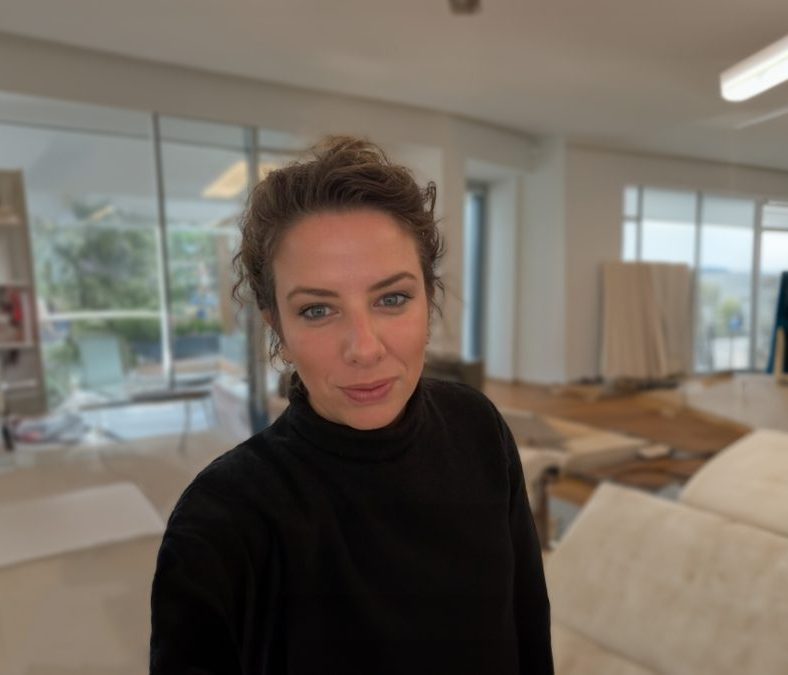
Charlotte Wissel, founder of Artemis Virtu. (Credit: Courtesy of Artemis Virtu)
Each Piece of Her Furniture is Tailored to Clients’ Tastes
Charlotte Wissel’s design company, Artemis Virtu, collaborates with customers on crafting furniture that’s made to suit their individual tastes.

For Charlotte Wissel, furniture has always been about more than function or necessity – it’s also an alternative form of expression. Wissel told us, “I see each piece as a blank canvas with the potential to become a work of art.” In 2020, the Fort Lauderdale, Florida, designer launched her company, Artemis Virtu, through which she aims to combine craftsmanship, storytelling and bold design into something tangible and lasting. Wissel also takes upholstery to another level by integrating custom materials and original artwork into every project.
Here’s our lightly edited Q&A, from The Story Exchange 1,000+ Stories Project.
How is your business different from others in your industry?
We treat upholstery as an art form, not just a service. While many upholstery businesses focus solely on repair or restoration, our work goes far beyond function — we design statement pieces that transform a space. We’re not just reupholstering furniture; we’re creating one-of-a-kind pieces that reflect the client’s vision, style and story.
Tell us about your biggest success so far.
Seeing my work featured in homes I never imagined I’d have the opportunity to be part of. Over the past year, I’ve had the honor of creating custom pieces for private clients whose taste and stature I deeply admire — individuals I never expected to connect with, let alone have my artwork in their personal spaces.

What is your top challenge and how have you addressed it?
Like many creatives-turned-entrepreneurs, I quickly learned that talent alone isn’t enough to build a business. One of my first challenges was navigating the startup phase — figuring out pricing, sourcing materials and positioning myself in a niche market. I had to learn how to run a business while still being the creative force behind every piece, which meant wearing many hats and making decisions that didn’t always come naturally at first.
As the business began to grow, scaling up became the next big hurdle. I found myself reaching capacity quickly, with more requests than I could handle solo. It forced me to evaluate how I could grow without compromising the quality or uniqueness of my work. I’ve since streamlined my process, established stronger boundaries around production timelines, and begun forming partnerships that allow me to take on more without losing the personal touch.
Have you experienced any significant personal situations that affected your business decisions?
As we began to gain traction, I was thrilled to see demand increase. I hired staff, took on large-scale projects, and worked with designers on high-volume orders. On the surface, it looked like success — but in reality, I found myself drifting further and further from the soul of what I had created.
Many of the pieces I was producing no longer felt like mine. I was executing someone else’s vision, with little input or creative freedom, simply because they had seen my past work and wanted me to replicate it. It became clear that I was on the verge of turning my studio into a production line, and that was never what I wanted this business to be. So, I made the conscious decision to recalibrate — to scale with intention, not volume.

What is your biggest tip for other startup entrepreneurs?
Trust your instinct and protect your craft. In the early stages, it’s easy to feel pulled in every direction by trends, advice or what you think people want from you. But your vision is the core of your business – it’s what will set you apart.
How do you find inspiration on your darkest days?
I’ve learned to take a step back and reconnect with my “why.” I reflect on the pieces I’m most proud of, the clients who trusted me with their vision, and the moments that reminded me that I’m doing what I love.
But more than anything, I remind myself how lucky I am to create art as my work. As a child, making art brought me peace and calm — it was my favorite escape. Some days, it’s just about remembering that same feeling. Even now, when things get tough, reconnecting with that quiet joy of creating helps me find clarity and reignites my inspiration.
What is your go-to song to get motivated on tough days?
“Sympathy for the Devil” by The Rolling Stones. That song has such a raw, powerful rhythm — it always gives me a jolt of confidence and focus when I need it most.
Who is your most important role model?
While I wouldn’t call him a traditional role model, one of my greatest creative inspirations is the artist Dean West. His dedication to detail is extraordinary — he often spends days, even weeks, orchestrating every element of a single photograph, waiting for the perfect moment and light, even when nature works against him. His piece The Wrangler is a personal favorite of mine. It’s a masterclass in patience, precision and storytelling through visual art. ◾
Instagram: @artemisvirtu
Check out our Advice + Tips for entrepreneurs starting-up
Watch our latest videos
Subscribe to our podcast